
Meditations on Yellowstone
Part V: Mirrors
“We have no need of other worlds. We need mirrors. We don’t know what to do with other worlds. A single world, our own, suffices us; but we can’t accept it for what it is…”
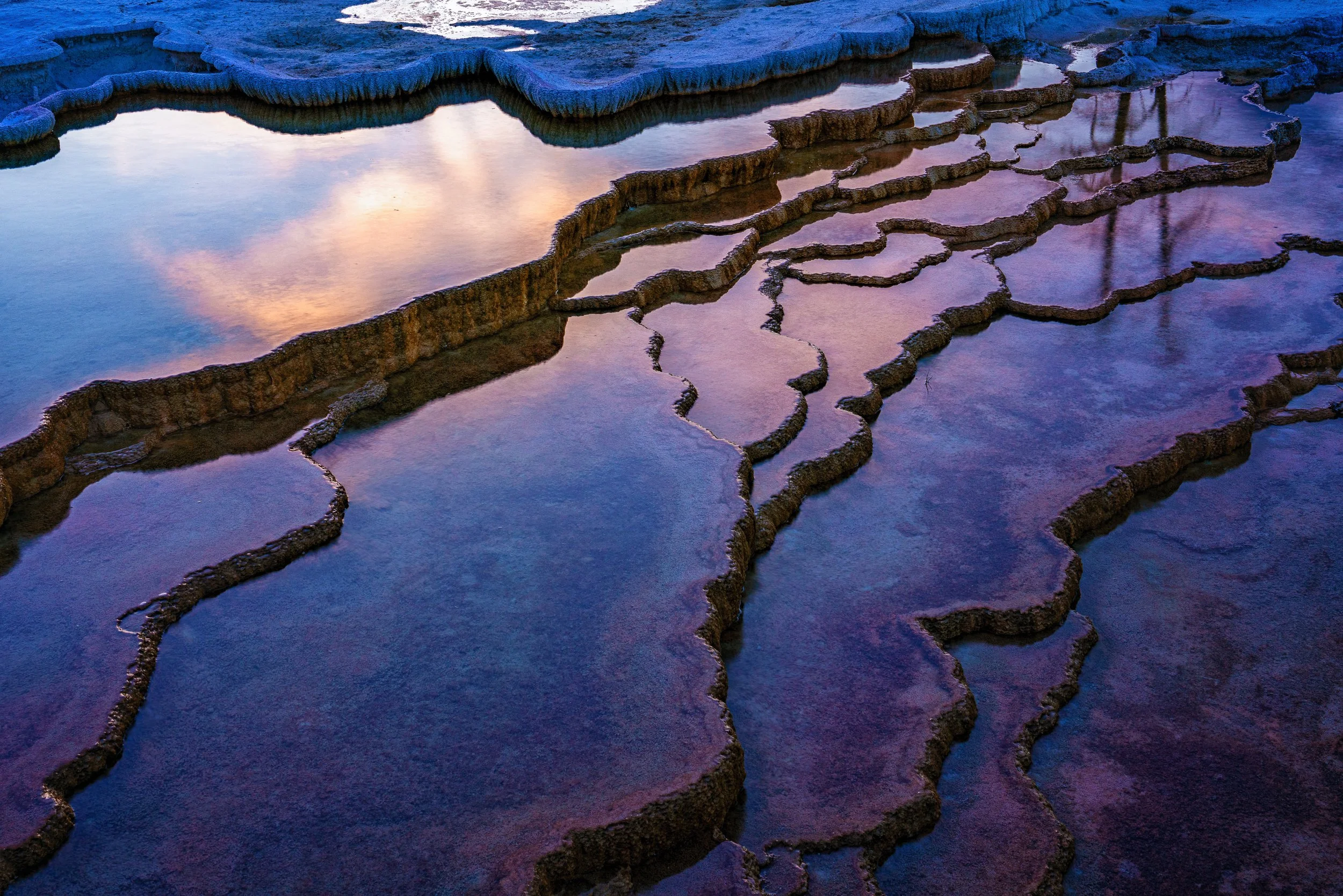
Reflections of the dusky sky in the layers of Mammoth Hot Springs in Yellowstone National Park.
It was the meme shared around social media last month and one that sadly seemed all too familiar: a tourist being attacked by an aggressive bison in a campground in Yellowstone National Park. Even more predictable was the cascade of sniggering and snide comments that followed:
“good. if someone walked in to my living room and took pictures of me then wanted me killed for flipping him around that wouldn't be fair.”
“I'm on the Bison's side on this.”
“Can’t fix stupid!”
These were accompanied by numerous images of the airborne individual photoshopped into scenes of jumping off of a skateboard ramp, falling out of an airplane and even floating in outer space. The epithet “touron” (moron + tourist) was also liberally tossed around by media outlets—respectable and otherwise—as if once again another rube had gotten their comeuppance for flouting the rules and ignoring all common sense to snap a picture of wildlife.
There’s just one problem with this narrative.
He didn’t deserve it.
The opprobrium, that is. The scorn. The ridicule.
He was just in the wrong place at the wrong time.
The video of the incident reveals that the gentleman, Carl Isom-McDaniel, 65, was out walking with his grandson through Bay Bridge Campground on July 10 when they spotted a bison resting on the ground. They stop to take a picture from what would appear to be a reasonably safe distance (McDaniel’s family estimated around 100 yards, though I’m dubious of that number based on the video—the National Park Service recommends at least 25 yards or 75 feet, which seems a more reasonable guess as to their location) before a truck passed in between them and the reclining animal. What happens next is almost a blur: the bison rolls on the ground and then begins to exhibit aggressive behavior, perhaps agitated by the vehicle, and proceeds to charge the road. (Viewers on the scene observed that this same bison had run towards some young people prior to this incident, and they had also done nothing directly to provoke the animal.) McDaniel and his grandson have already moved on along their path, unsuspecting of the now rampaging ungulate. Alarmed, McDaniel and his grandson quickly rush into the patch of trees located in front of them and briefly disappear from view, before McDaniel reemerges on the other side. Unfortunately he miscalculates the direction the animal takes and is immediately confronted by the rushing behemoth and turns to run away, only to be caught by its horns and thrown roughly 8 feet into the air before crashing to the ground. Fortunately McDaniel survived the attack but not without suffering several broken bones, though apparently not a broken spirit as he was found to be cracking jokes with the first responders (including the person who caught the footage, a professional photographer and wildlife expert.)
Fatalities due to wildlife attacks are exceedingly rare in national parks. Only 3 died from wildlife encounters between 2014 to 2019 according to the National Park Service despite the millions of visitors seen across the 63 parks each year.* Injuries, on the other hand, are too numerous to keep track of, and often they are the result of thoughtless dunderheads who think they are at a petting zoo or Disneyland. Social media is replete with visual evidence of these Pandoras tempting fate while trying to capture the perfect selfie. (Or more likely getting dangerously close and then nothing happening to them, emboldening future dimwits to try to feed a bighorn sheep or touch a bison’s fur.)
But then there are people like McDaniel, unwitting victims who were distracted and unable to process what was unfolding in front of them. The video shows that he and his grandson were looking at their phones, most likely because they had spotted the animal prior to the recording and were opening their camera apps. Once he was cognizant of what was happening, he resorted to instinct in running towards the tree line, yet after he reappears in the scene his grandson is nowhere to be found. It turns out, according to Mike MacCleod, the videographer of the incident, that
“Carl told his grandson to run along the road and go back to the place where they had just come from while he lured the bison away,” MacLeod said. “So, he saved his grandson’s life.”
Of course, that part of the story is almost nowhere to be found among the hundreds of posts sharing the image of the hapless McDaniel. The video is also frequently not included, or at the least heavily edited to feature the attack and none of the context necessary to adequately frame what occurred. (Even the interview with MacCleod omits a lot of the footage and needlessly replays the attack in the background).
Yet I’m willing to bet that very few of those keyboard contrarians sharing their knee-jerk responses (“Darwinian evolution in action” reads one of the comments below the Associated Press report) even bothered to watch the entire video or endeavor to find out what happened in the first place. They had simply arrived at their predetermined conclusion.
To be fair, within the last few weeks I have also seen stories about
Two women walking onto the Grand Prismatic Spring at Yellowstone (an incredibly dangerous act that not only damages the fragile crust but could give way and scald and possibly kill)
That last one is a satirical post, but in the vein of John Oliver, you can almost believe it, can’t you? I mean, that just seems too plausible to be fake. (A quick survey of Facebook would show that many did, in fact, believe it). With the constant barrage of stories about these kinds of reckless behaviors, it’s almost understandable that people would be predisposed to judge McDaniel before they had gathered all the facts. It’s beyond unfortunate, but it was my first instinct, too.
Let’s begin with a thought experiment. Look at the two images below (first pic not mine, credit listed):
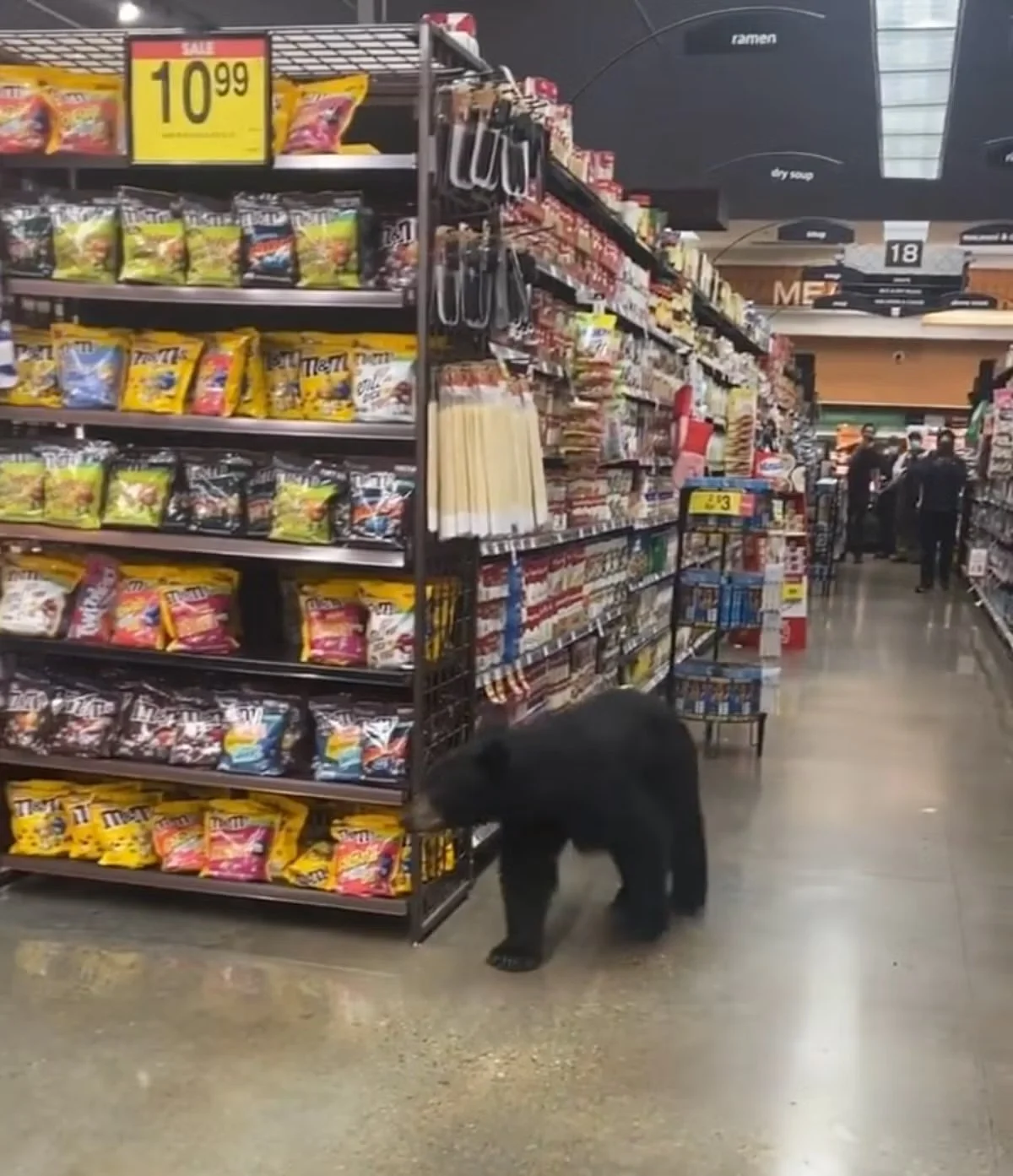
(Instagram/Tish Campbell)
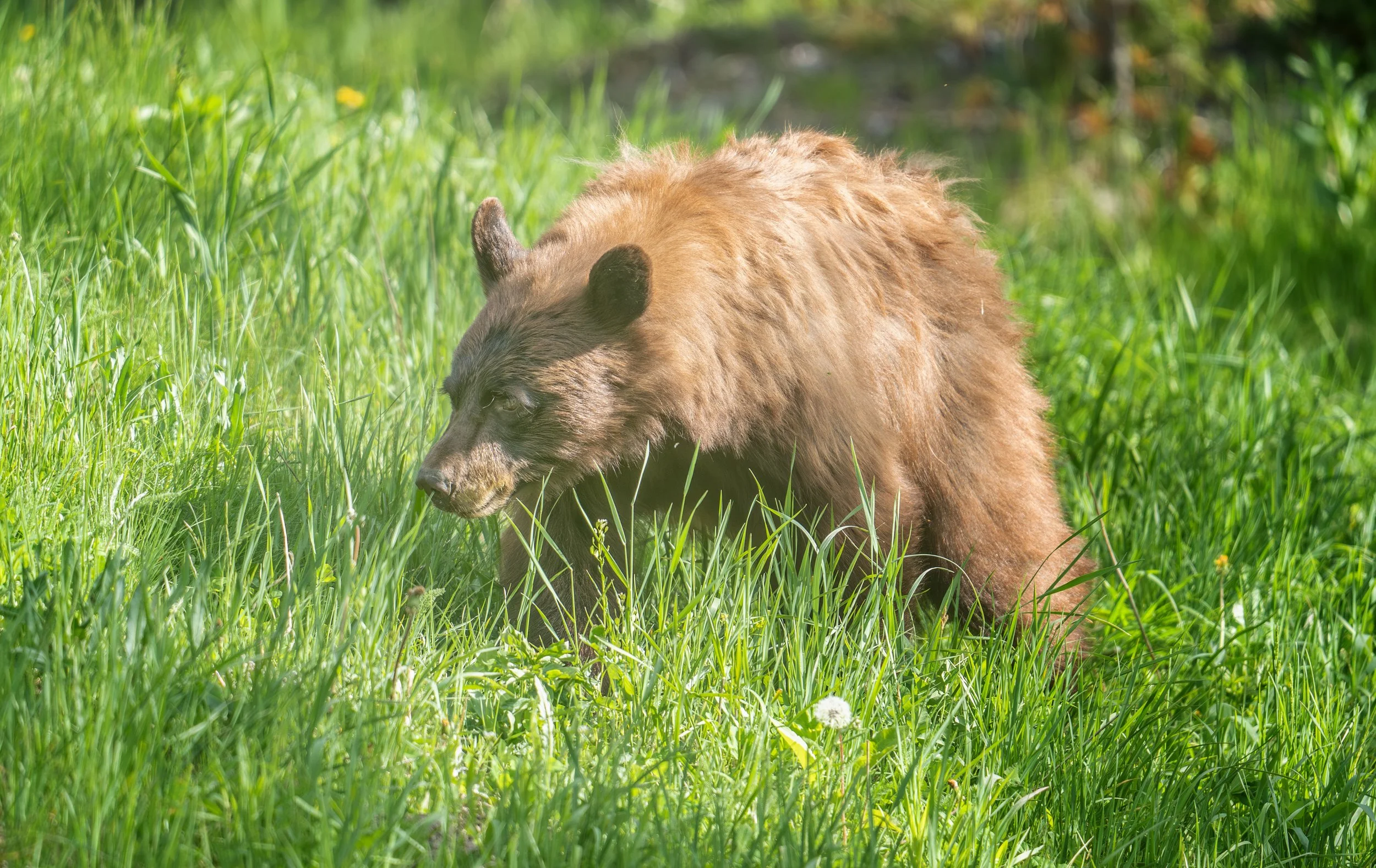
(Image mine)
The answer to this question should seem rather easy, but which picture of a bear appears to be in its natural habitat? Simple, right? Okay, which image would terrify you more if you came across this animal unexpectedly? This might require a little more thinking, as the picture on the left would probably be your answer depending on your proximity to the animal and/or the exit. The picture on the right could also qualify if you were on a trail and happened to be just a few feet away when you encountered the bear. You might instinctively think about running or hiding, or reaching back into the recesses of your mind to try to remember if you should act big and try to scare it off, or curl up in a ball and hope for the best. (Here’s the answer, by the way.)
Here’s another question, though probably one you hadn’t thought of at first: which picture indicates a problem for the bear? Most would probably choose the picture on the left, clearly because we know the bear isn’t where it should be and is most likely panicked. The best possible outcome would be for the bear to leave through the door while accosting no one, while the worst could involve up to and including euthanizing the animal if things took a dark turn. For the picture on the right, most would think that the bear is in its natural habitat, so the problem almost entirely resides with the viewer, not the animal. (For the record, I was a good 100 feet away, which is less than the NPS recommended 300 feet, I’ll admit.)
You might think that the answers to all of these questions were obvious, as we have a natural wariness of bears in our popular imagination and I provided a clear distinction between each situation. Let’s change things up. Look at these pictures:
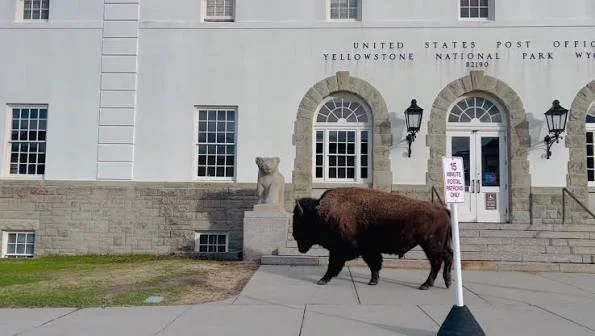
(Facebook/Tanya Saueressig)
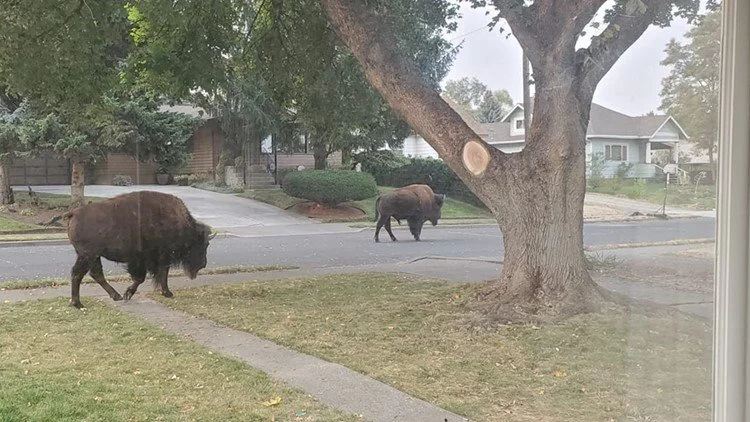
(Still image from a video taken by Mizu Howell, KREM.com.
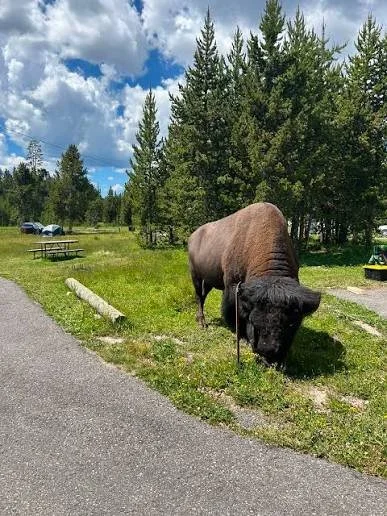
(Facebook/Emmylou Abrahamson)
You can think about all of the previous questions I asked for the bear pictures, but let me start with a new one: if you had to rank the pictures in terms of proximity of the bison to its natural habitat (1-closest to its habitat, 3-farthest from its habitat), you would probably put the last picture as the closest, but what about the other two? You might make them equal—they both seem out of place. But why did you choose the campground? Is it because that would be your instinct (there are trees and grass, after all), or is it because I forced you to make a choice based on the context of the other two pictures? Additionally, would you feel threatened in any of these situations? Again, proximity to the animal does play some part, but would you have the same natural revulsion as you would to a bear? Probably not, especially if you had spent any amount of time watching bison grazing in a pasture and concluding that they were similar to cows as large mammals uninterested in those observing them.
Finally, which picture/s would be bad for the bison? Probably the first two, especially number 2, considering this is a city street. (If you look closely, the first is a post office in Yellowstone itself, so while it isn’t technically in its immediate habitat, it is certainly much closer. And one might even conclude that the building itself is in the ‘wrong’ place, unless you were to see the other buildings located nearby. The P.O. is next to Fort Yellowstone, the former military establishment inside of the park that is now home to a museum and visitor center.) Would the campground? Or would it be considered more of a “transitional space”? We’ll come back to this later.
Now put yourself in Carl Isom-McDaniel’s shoes. He didn’t encounter the bison in a truly “civilized” space, but I would argue that where he was had has much to do with the attack as if he had run into it in a grocery store. In fact, I wouldn’t hesitate to say that his location had a greater impact on the outcome than if he had turned the corner at the local Piggly Wiggly and came face to face with his hairy adversary rifling through the Chex Mix. Part of the reason involves a problem of perception.
“One man’s wilderness may be another’s roadside picnic ground,” writes Roderick Nash in his seminal history of conservation in America, Wilderness and the American Mind. “The Yukon trapper would consider a trip to northern Minnesota a return to civilization while for the vacationer from Chicago it is a wilderness indeed…Wilderness, in short, is so heavily freighted with meaning of a personal, symbolic and changing kind as to resist easy definition.”
Now I would have considered myself, while not exactly an expert, certainly someone with a clearer understanding of the delineation as to what wilderness would mean when compared to the average suburbanite. But in the process of planning this series of blog posts on my 2024 trip to our country’s first national park, it slowly occurred to me that maybe I really don’t have any special insight into this process at all. In fact, when working on some early promotion for my book, Illuminating Nature, just prior to heading to Yellowstone in June of that year, the publisher had asked me to contribute a few answers to some pro-forma questions regarding the intended audience for this book. “Well, obviously for anyone who loves nature,” I thought to myself when drafting initial responses. Seemed self-evident really, and of course I’m included in that group because I take pictures of nature, right? I know how to show the proper respect. My mere presence among the flowers and hills and wild animals surely demonstrate my commitment and sympathy to the preservation of the natural world. It’s only when I had to articulate that love and passion that I realized that I hadn’t given much consideration to this “fraught” idea of wilderness. I found myself appealing to other writers, naturalists and artists when crafting my raison d’etre for composing the book, and in writing this series of meditations I still find myself struggling to understand what exactly we mean we use the words “wilderness” or “nature.” Perhaps the commonly held belief that they are referring to the same idea is where the confusion begins.
Nash contends that “wilderness” is a relationally defined term, meaning that it only makes sense when we have an understanding of what “civilization” is. Over time the idea of wilderness has changed as the idea of what being civilized is has evolved. When the first European explorers encountered the primeval forests and pristine river basins of the New World in the 16th and 17th centuries, there was an understood difference between what they had left behind (the dense, overpopulated and polluted cities of Western Europe) and what they were heading into (though not much of a clue what they would find once there), but turn the dial back several millennia to the hunter-gatherers and nomads of the prehistoric era and there would be almost no boundary to consider. It would have been all habitat, Nash writes, with nothing tamed. Slowly the idea of wilderness came to represent an obstacle to development and/or settlement, an inhospitable territory to be either conquered or left alone due to the inherent dangers of trying to survive in it. When we contemplate the few remaining wildernesses in the world today (the Amazon or the Outback), we must define them not only in terms of what they are largely missing (electricity, cell signals, sanitation systems) but also what they contain (and, controversially for many, to extract and exploit).
Nature, however, is a semantically flexible concept that can encompass elements of wilderness (think wild animals and naturally occurring flora), but can also include outdoor recreation, preservation of anthropological and historical sites, scientific exploration and some limited human cultivation and habitation. Robert MacFarlane in his book The Wild Places suggests that there is a fluidity in defining nature, where the difference is almost as much in mindset than in designation. He notes that throughout the United Kingdom, curated forested lands and nature preserves sit alongside the sparsely populated and virtually undeveloped coasts and islands of Scotland and Ireland, yet both could be considered natural (or ‘wild’, as he uses the terms somewhat interchangeably) as they can connect us to something outside of our ourselves as humans:
“Wild animals, like wild places, are invaluable to us precisely because they are not us. They are uncompromisingly different. The paths they follow, the impulses that guide them, are of other orders. The seal's holding gaze…the hawk's high gyres : such things are wild. Seeing them, you are made briefly aware of a world at work around and beside our own, a world operating in patterns and purposes that you do not share. These are creatures, you realise that live by voices inaudible to you.”
MacFarlane does see the challenge in maintaining that boundary. England might just be the most cultivated country on the planet, and he fears that once we lose that connection to the natural world through unchecked human development, we may be setting ourselves up for civilizational ruin. In that case, people are essential in this framing, and the more they can be encouraged to get out and explore, the more they may see the value in the preservation, provided they are aware of this fragile, delicate balance:
“We cannot navigate and place ourselves only with maps that make the landscape dream-proof, impervious to the imagination. Such maps – and the road-map is first among them – encourage the elimination of wonder from our relationship with the world. And once wonder has been chased from our thinking about the land, then we are lost[…]We are, as a species, finding it increasingly hard to imagine that we are part of something which is larger than our own capacity. We have come to accept a heresy of aloofness, a humanist belief in human difference, and we suppress wherever possible the checks and balances on us - the reminders that the world is greater than us or that we are contained within it.”
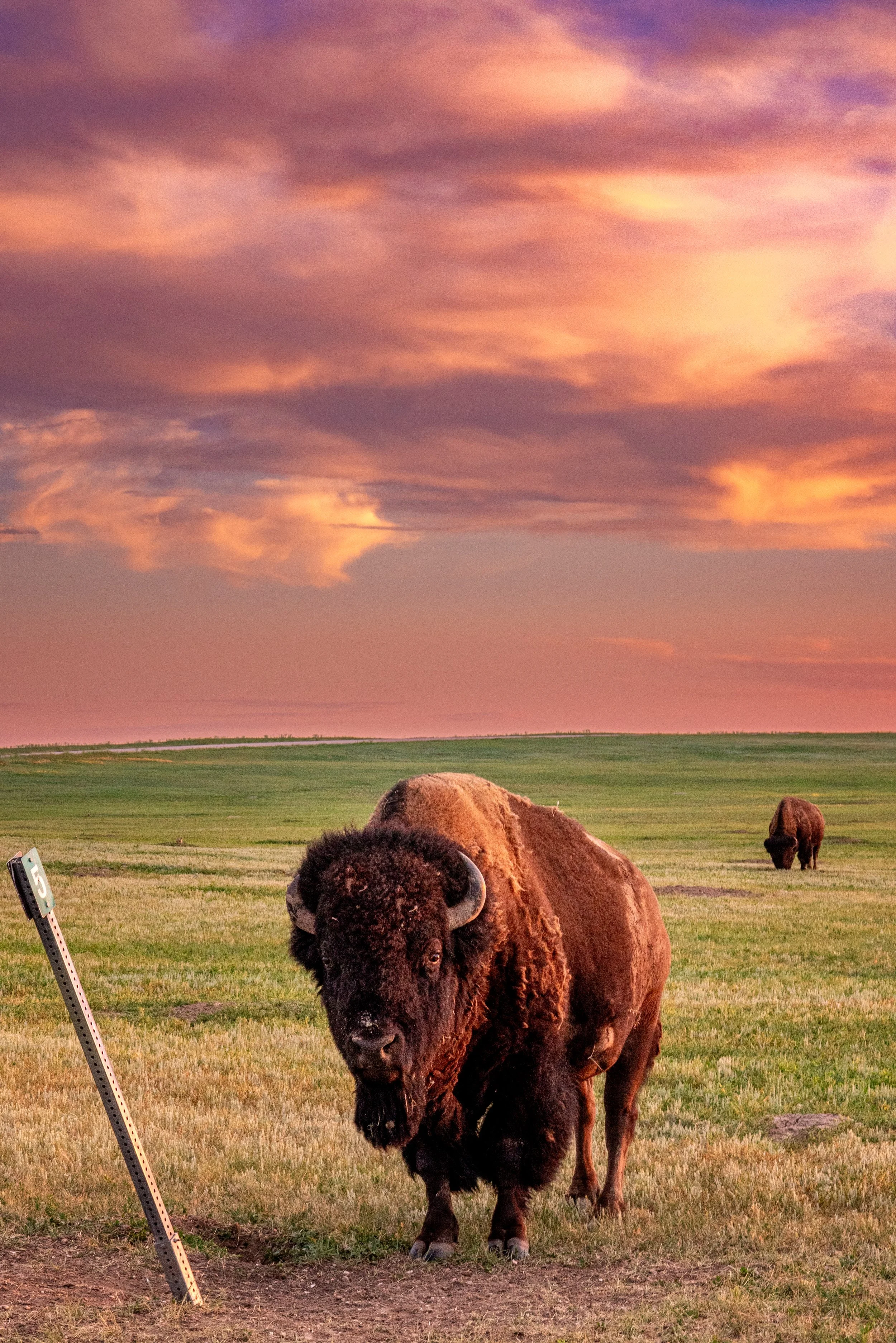
A bison stands next to his favorite scratching post, a mile marker sign on the Sage Creek Road in Badlands National Park, South Dakota. (Don’t worry—I was a good 75 feet away when I took this pic!)
Other writers such as Ralph Waldo Emerson, Henry David Thoreau, John Muir, Aldo Leopold, Mary Oliver, Margaret Renkl, Wendell Berry, and Nan Shepherd offer varying ideas about what constitutes the natural world yet they also share a core thread that we as humans have a place in it. Some might even contend that these writers could be placed on a spectrum as to how much human interaction can and should be tolerated. I don’t know exactly how to align them based on their attitudes, only to suggest that Leopold and Berry may represent one antipode where a respect for nature is balanced with the agrarian needs of society, while Muir represents the opposite due to his frankly racist attitudes towards indigenous communities. All of them would agree that nature is not a space apart from us to be feared or dominated, but generally an ethical good to be maintained and preserved for the health of our body politic. We can find myriad opportunities to engage with the natural world and to seek solace and solitude while still needing to be mindful that the markers of civilization necessary for access to these spaces (ex. sidewalks, parking lots, visitor centers) can create a false sense of security against the more dangerous and unpredictable situations found within.
Out of all of the national parks I have visited, Yellowstone is the perfect embodiment of the wilderness/nature dichotomy. On the one hand, it is a vast caldera, with its general borders crossing into 3 states (Wyoming, Montana and Idaho, with the Cowboy State claiming 96%) at roughly the size of Delaware and Rhode Island combined. Among the national parks requiring an official pass to enter, it is the 2nd most visited (and no. 1 overall if Grand Teton National Park visits were included), and the month that I visited (June, 2024), the park was seeing almost 30,000 visitors per day. What makes this particular number even more impressive is that 91% of the land in Yellowstone is managed as wilderness, meaning that there are no developed pathways or campgrounds (only primitive) in these areas. By contrast, Great Smoky Mountain National Park, the most visited park overall in the system, has roughly 77% of its territory designated as wilderness with approximately 44,000 daily visitors during the same month, yet Yellowstone has around only a third of the road capacity when factoring in miles of road per size of the park.
On the other hand, Yellowstone has all of the modern conveniences one might expect to find in a resort, though spread out over an immense expanse of land. It has 7 gas stations, 18 dining establishments, and 12 general stores with options to buy groceries, camping items and various other souvenirs. In addition, it has 9 lodges, including the famous Old Faithful and Mammoth Hot Springs Lodges, with a total of over 2000 rooms accommodating any where from 4000 to 6000 guests per day in peak seasons. The park also has 11 established campgrounds, all within a short distance of the main park roads, some with amenities such as running water and electricity and some with primitive toilet facilities like Indian Creek Campground where I stayed. It’s this last point that I want to hone in on, because the incident with Carl Isom-McDaniel occurred at one of the developed campgrounds near Yellowstone Lake, a popular tourist spot in the park. Hundreds if not thousands of people are moving in and out of this location all day during the summer because of its proximity to the boat marina, especially in July as it is the busiest month in the park. RVs and camper vans can be found at the same campground and also at Fishing Bridge RV Park a few miles away. There may be days when one can roam the area and not see any wildlife at all in and around the area due to the amount of human activity.
And then there days when a coyote or moose could pass just a few feet in front of you, oblivious to your presence.** When I was photographing the Milky Way over the Moulton Barn in Grand Teton National Park just a couple of days prior to entering Yellowstone, I had heard a loud snort out in the darkness behind me. I remained perfectly still until it seemed the sound had passed, then I continued until the clouds rolled in and I returned to my car. A few hours later I came back to shoot sunrise over the barn only to see a bison reposed in the field just beyond the fence line, mere yards away from where I had been. Every photographer, hiker and casual nature enthusiast has anecdotes like these to add spice (and even some embellishment!) to their travels, but for every near miss there is a story of an unsuspecting backpacker being ambushed in the backcountry by a grizzly protecting its cubs. Now it’s not exactly a fresh take to say that anytime you bring humans into a wild animal’s habitat there is a very high probability of injury or even tragedy, and I would submit that George Isom-McDaniel would have agreed with that statement even before his unfortunate encounter. I would further submit that those reading this (yes, all three of you—hi, honey!) would agree with that sentiment as well.
Returning to our problem of perception, I think it’s important to recognize the challenges Mr. McDaniel faced, both consciously and unconsciously. He was walking through a developed campground, surrounded by cars, tents, and even other people walking around the area. Not exactly like the two images of the bison walking around buildings and houses, but in an area familiar enough to the signs of civilization to lull anyone into relaxing their defenses. Of course, if we were to see a bear loping around, most of us would keep a wary distance because we would feel vulnerable, but put it on a road in the middle of Yellowstone, we might relax a little more though still understand the danger. (I know, I’m making a pretty big assumption here, as I witnessed a few people get dangerously close to the hirsute friend I took a picture of above). Bison, however, don’t instill the same fear. From a distance they seem relatively passive and aloof.
Let’s return for a moment to my earlier thought experiment. While we can easily see a distinction between animals completely out of their habitat and those completely in them, we rarely think about their safety on their own terms. A bear or bison roaming the streets of a mountain town may cause some concern regarding getting hit by a vehicle, but I would bet that more people would still see them as somewhat of a threat (or at the very least a nuisance) because they are clearly out of their element. My wife and I saw a brown bear pawing through some trash cans at an adjacent street to a restaurant we were entering in the mountain town of Ouray, Colorado a few years ago, and almost all of the passers-by informed us that it was here all the time foraging for food. Not a single person batted an eye or ran for cover, nor did they express any immediate sympathy for its plight. But they also didn’t try to approach it, either. Now, place that bear or bison in a campground, and the perception might change. It would not be unusual to see a bear rifling through some camper’s thoughtlessly unprotected leftovers, a moose walking in between tents or a bison lying about in a green space next to the bathrooms, but it would still be unexpected. The ultimate goal for the camper, though, would be the same as if the animal entered a convenience store: to restore order and harmony for the human. What happens to the animal is secondary, if even considered at all.
Daniel Kahneman, a Nobel winning behavioral economist, popularized the term cognitive ease (or fluency) to describe
“[t]he mental state of being relaxed and at ease, which makes thinking feel smooth and effortless. It refers to how easy or difficult it is for our brains to process information. The easier something is to understand or process, the more likely we are to accept it as true or familiar.”
Kahneman noted that we make judgements based on how quickly we are able to find mental equivalents from our own experiences and implicit biases. (Malcolm Gladwell referred to them as “snap judgements” in his popular book, blink). The harder we have to work when presented with a novel idea is termed cognitive strain. Much of what contributes to this distinction for the person whose mental state is being tasked is how frequently they’ve encountered this specific situation and how much they are disposed to avoid the strain. In the book Human Error, James Reason emphasizes that when multiple strands of information (“inputs”) are being presented to the participant, it will almost be inevitable that they will resort to a reductive approach and appeal to the bias of frequency simply because their “personal workspace” is overloaded. Their “buffering” ability can be completely overwhelmed if too much of the information is new or rarely encountered, so they will often immediately resort to a previous experience (whether direct or something vicariously observed such as in movies, television or social media) to find a solution to the situation.
Once again let’s return to the thought experiment. Seeing a wild animal in its habitat is perfectly normal, if not a little surprising to someone hiking on a trail. But we know there is a chance, even if we ignored every interpretive sign or physical evidence, that a wild animal could appear. In a grocery store, while we could intellectually accept that a wild animal would enter looking for food (especially if you live in a gateway town such as Gatlinburg, Tennessee), we would be most surprised to turn the corner and see Yogi preparing for a picnic. But now enter a national park, with its mix of wilderness, historical and recreational areas, boat marinas, restaurants, lodges, and even an airport, and our brains are suddenly tasked with many contradictory inputs. Are we in a wilderness? If we see a coyote hunting for pika in a meadow but we are standing behind a fence, is this nature or some kind of zoo? Are we safe to observe this behavior? If that same coyote enters one of the bathrooms, do we run screaming, or do we continue on our merry way to the stall?
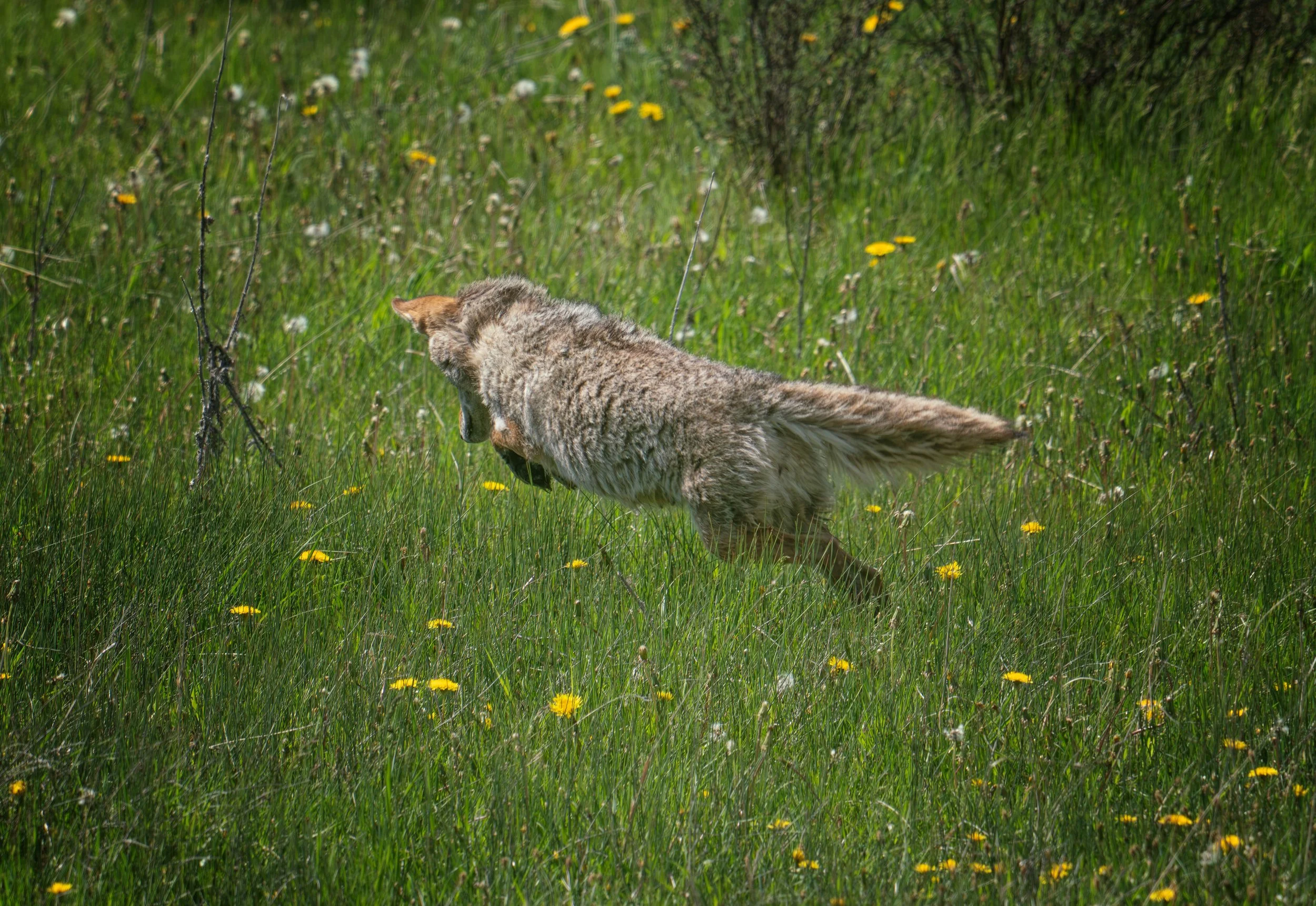
A coyote goes pika hunting in a meadow in Grand Teton National Park.
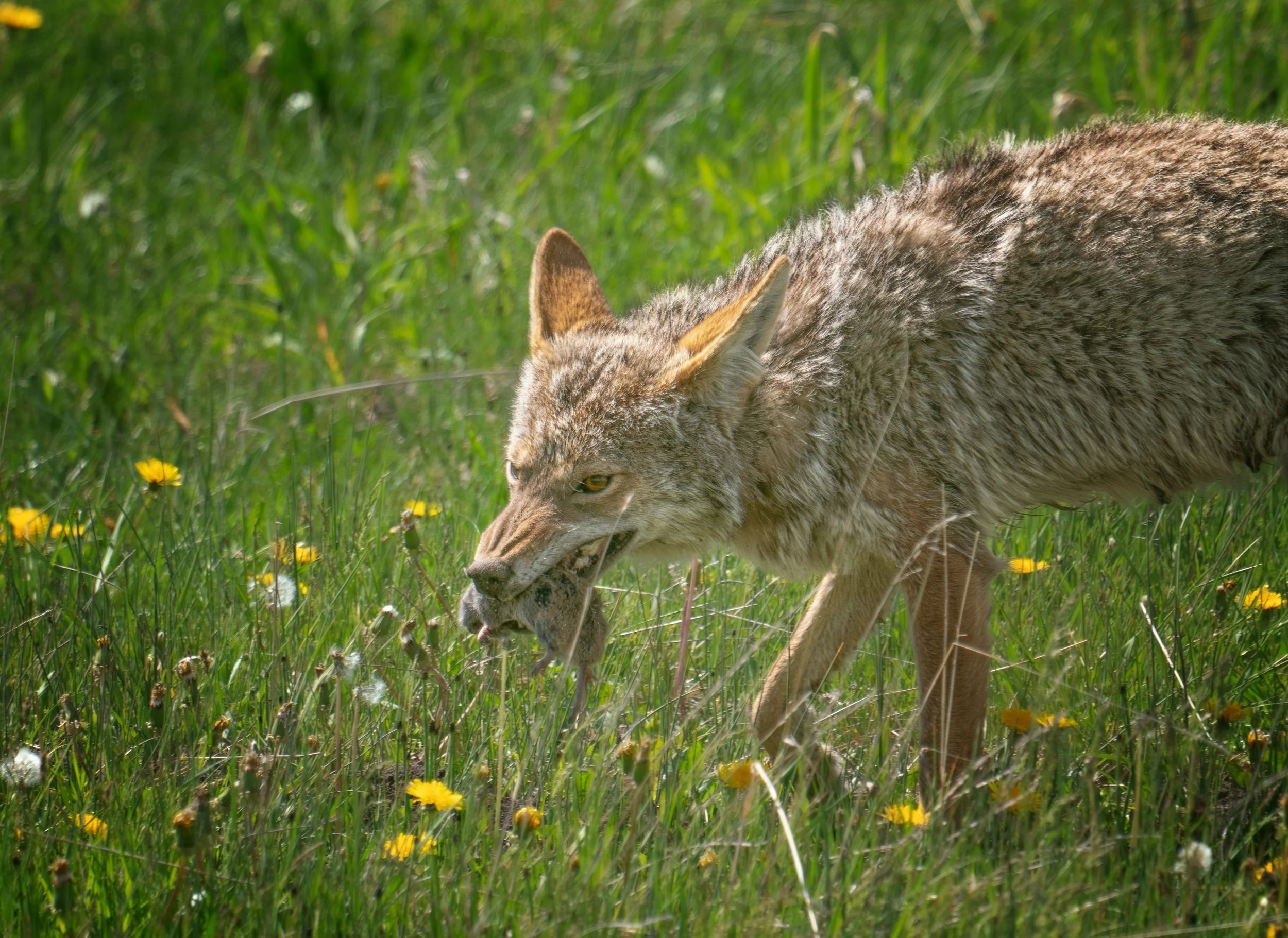
He found his prey! (By my count, he caught at least four in about 10 minutes!)
Unfortunately cognitive ease is often associated with just being lazy or thoughtless, which in essence is true when thinking about most people’s natural dispositions. But for individuals like Carl Isom-McDaniel (and me, for that matter), it is fighting the instinct to stop and photograph an animal that one expects to see in a national park without immediately comprehending that, despite being in a campground surrounded by cars and separated by a road, it is the animal that is in its element, and it will do whatever it must to protect itself. Even exerting some form of cognitive strain such as keeping one’s distance—which may not have been a strain for McDaniel and his grandson because we frankly don’t know what their prior experiences were, though the very least they didn’t come any closer to the animal—served to minimize the potential damage. But in the end, once McDaniel entered the park, he had given consent to the presence of wild animals, whether he truly understood the risks involved or not. I doubt that anyone would have been able to overcome the urge to admire a wild animal as that’s what we’ve been conditioned to do in a national park—it’s just that we often forget that wilderness doesn’t truly abide by the artificial distinctions we mentally apply. Once the bison started rampaging, McDaniel did what any of us would have done—he sought self-preservation and fled for his life.
Edward Abbey, the conservationist/anarchist, anticipated these problems in his book of essays, Desert Solitaire. Back in the late 1950s Abbey served as a park ranger in Arches National Monument, later National Park in 1971, and already he was observing the dangers of making wild and natural places too accessible to the general public:
“How to pry the tourists out of their automobiles, out of their back-breaking upholstered mechanized wheelchairs and onto their feet, onto the strange warmth and solidity of Mother Earth again? This is the problem which the Park Service should confront directly, not evasively, and which it cannot resolve by simply submitting and conforming to the automobile habit.”
Abbey was describing the idea of cognitive ease before it had entered the public consciousness. By striving for a frictionless experience, the National Park Service was discouraging the majority of people from valuing the park on its own terms (as he saw it.)*** Rather, NPS was contributing to the further alienation of people from the natural world and, in the process, from themselves. He knew that once it was made it too easy for people to enter a natural space, they will just see it as an extension of the world they already inhabit:
“Industrial tourism is a threat to the national parks. But the chief victims of the system are the motorized tourists. They are being robbed and robbing themselves. So long as they are unwilling to crawl out of their cars they will not discover the treasures of the national parks and will never escape the stress and turmoil of the urban-suburban complexes which they had hoped, presumably, to leave behind for a while.”
It seems somewhat fitting then that according to the National Park System, 98% of visitors to Yellowstone go only a quarter of a mile beyond the car parks and boardwalks. To that statistic I can add that the nearly three days in the park I saw almost every well-known feature and wild animal (except a wolf) without having to exert that much effort. The park’s overall transit design is well-suited for just that purpose, despite the suffocating traffic and hordes of tourists. But because so much of the park is remote, it was possible to find solitude once I hit a trail for even just a half hour. Again, a somewhat contradictory and disorienting experience. It would be like exiting a stadium immediately after an NFL football game and then in just a few turns you are completely alone. For the thousands of visitors Yellowstone sees everyday, it would seem that the overwhelming majority of them never leave the stadium’s parking lot.
So what can be gained from all of this? What lessons can we take away so far?
That McDaniel was an unwitting victim of circumstances somewhat beyond his control and immediate comprehension? That seems a reasonable conclusion. He most likely didn’t see the bison’s previous behavior or even think about how long the animal had been lying in that spot. Late June and early July also begins rutting season when bison become even more territorial, which most likely contributed to its aggressive behavior.
That most people entering national parks never fully grasp that despite the trappings of civilization, they are still on nature’s terms? That also seems a given. The great English philosopher John Locke referred to this idea as “tacit consent,” whereby our mere presence confers a responsibility to understand the risks involved in any public space or activity. Though he was referring to the notion of consenting to be governed by the rules and regulations of the political entity in control of those spaces, I think we can logically extend this idea that once we enter a national park, we are required to learn the rules and behaviors of the natural world and not at liberty to ignore the possible consequences.
That people rush to judgement on the internet before all of the facts are in? Not a hot take. Cognitive ease at its absolute finest/worst.
That social media specifically is a rage-bait machine algorithmically driven to short-circuit our thinking? That is also apparent, but I think it speaks to a larger problem that pre-existed the online world and now simply amplifies the deeper problem running through all of this:
We are fundamentally incapable of seeing the world apart from ourselves.
Everything we touch or interact with winds up becoming an extension of our collective consciousness. Instead of being positively transformed by the technologies we create or the new frontiers we discover, we inevitably turn them into projections of our anxieties and desires. The tools we design ostensibly to help improve our lives almost always corrupt us in one form or another. Even when we seek engagement in the natural world, the very methods we employ for exploration contain the vast potential to destroy, both the environment and ourselves in the process.
Nash discusses the very contradiction at the heart of this dilemma regarding the natural world, in that when we seek to preserve wilderness, we inevitably commodify its benefits and eventually degrade its existence as we seek to increase its social utility. In the case of the Grand Canyon, geological exploration and scientific curiosity led to its designation as a National Park, which in turn brought development and near unrestricted popularity and desire for access. The evolution of the history of the monument is itself a perfect illustration of the “fraught” idea of attempting to define wilderness as stated earlier in this blog.
Nash writes:
“…[W]ilderness management is a blatant contradiction in terms. By etymology, wilderness is uncontrolled. Wild places and wild animals were those which man and civilization…[cannot] control…The bureaucratic and then legal designation of wilderness areas began in subtle ways to erode the uncontrolled essence of wilderness.”
Once humans have applied labels, they have applied restrictions and designated limits. The trappings of accessibility such as roads, bathrooms, recreational spaces can bring people into spaces, but in the end they actually become civilizational permits for more activity, which in turn may bring a heavy hand to manage and restrict, and thus the true wilderness experience is no more. Because wilderness still carried negative historical connotations in American history, it can also represent a demarcation between areas safe for human habitation versus land whose only purpose is to be financially exploited. It’s important to remember that Nash was writing about this in the early 1980s, only a few years after Alaska was becoming the next epicenter of the wilderness debate after the completion of the Alaskan Oil Pipeline in 1977 and several animal habitats and tribal lands were at risk. Today we have the seemingly never-ending controversy of preserving Bear’s Ears and the Escalante regions in Utah, lands claimed as sacred by the Navajo, Hopi, Ute and Zuni tribes, among others. Escalante was the last unmapped region in the United States as recently as the John Wesley Powell expedition in the 1870s, and its status as wilderness had kept it from becoming a full-blown national park (they were designated as National Monuments under the Obama administration), but the current Trump administration, with the backing of the mining industries supporting it, has cited “national security” concerns in attempting to reduce the size of the protected areas. Many of the same arguments that Nash wrote about then are playing out now, and no doubt will continue to dominate our discourse about these remote areas both here and around the world.
But I digress. I started with the unfortunate case of an unwitting victim and the social media pile-on and turned his cause into a proxy for the larger issue of human egoism leading to civilizational myopia and potential collapse. But I wouldn’t be the first do so.
In his classic 1961 science-fiction novel, Solaris, Stanislaw Lem writes that we don’t truly want to know how things exist outside of our realm of understanding, because in the end we would be terrified of the answer. Instead we simply take any new discovery (in the case of the book, a sentient planet called Solaris which causes the scientists in its orbit to experience physical manifestations of people from their past) and convert it to an instrument to serve our own ends. Lem manages to bridge thousands of years of human exploration in a beautifully constructed monologue where one of the scientists informs a visitor on the space station sent to investigate the suicide of a colleague of this hard-learned truth. I’m going to include the entire passage below. (Emphases mine):
“We take off into the cosmos, ready for anything: for solitude, for hardship, for exhaustion, death. Modesty forbids us to say so, but there are times when we think pretty well of ourselves. And yet, if we examine it more closely, our enthusiasm turns out to be all sham. We don’t want to conquer the cosmos, we simply want to extend the boundaries of Earth to the frontiers of the cosmos. For us, such and such a planet is as arid as the Sahara, another as frozen as the North Pole, yet another as lush as the Amazon basin. We are humanitarian and chivalrous; we don’t want to enslave other races, we simply want to bequeath them our values and take over their heritage in exchange. We think of ourselves as the Knights of the Holy Contact. This is another lie.We are only seeking Man.We have no need of other worlds. We need mirrors. We don’t know what to do with other worlds. A single world, our own, suffices us; but we can’t accept it for what it is. We are searching for an ideal image of our own world: we go in quest of a planet, of a civilization superior to our own but developed on the basis of a prototype of our primeval past. At the same time, there is something inside us which we don’t like to face up to, from which we try to protect ourselves, but which nevertheless remains, since we don’t leave Earth in a state of primal innocence. We arrive here as we are in reality, and when the page is turned and that reality is revealed to us – that part of our reality which we would prefer to pass over in silence – then we don’t like it any more.”
Lem argues that we are hard-wired to use analogy and cultural-blindness to guide our actions, both on a personal level and as an organizing principle for civilization. Lest we think this applies only to European explorers/colonizers, even indigenous peoples such as the Lakota sought to dominate their rivals using the tools of technological advancement (guns, mostly) to further their own perceived superiority. As noted in my previous post, in the mid 19th century both the Lakota and the US had aspirations of empire envisioned through their own interpretative lens of manifest destiny, a cultural imperative whereby each side desired territorial hegemony in pursuit of the expansion of their respective worldviews. Unfortunately for the Lakota, their total dependence on the precarious natural world contributed to the almost complete loss of their civilization as they were unable to overcome the incursion of the railroad and dispossession of their lands. Ultimately they were overwhelmed in the face of technological superiority leveraged in pursuit not of cultural adaptation or accommodation but of subjugation.
But I digress again.
At the conclusion of Solaris (spoiler for a 65 year-old book!), the investigator is deeply disillusioned because he too had his ex-wife conjured into existence by the planet, and despite recalling the pain and agony of her earthly departure (she committed suicide, which she does again once she learns that she is merely a copy of her original self), he is left at the end of the novel bereft and hoping for her to reappear. Rather than continue with his current trajectory in life, he would rather pine for the world he thought he was desperate to leave behind. When presented with the opportunity to leave the station, to leave behind his suffering and loss and move on with his life, he resorts instead to the familiar, incapable of imagining a new path. He is left staring out to an indifferent planet, alone with his thoughts and contemplating the absurdity of wishing for a different outcome:
“Are we to grow used to the idea that every man relives ancient torments, which are all the more profound because they grow comic with repetition? That human existence should repeat itself, well and good, but that it should repeat itself like a hackneyed tune, or a record a drunkard keeps playing as he feeds coin into the jukebox…”
It is Lem’s deft ability to connect the civilizational with the individual that I want to highlight as I draw a close on this final meditation. As we stare into our computers or phones today, are we really seeking connection or community with others in order to learn something new and/or to advance our understanding of the world around us, or are we just seeing the reflections of ourselves on the screens? Instead of thinking of our devices as windows to new ideas and perspectives, are they really just mirrors where we don’t really want to know what’s on the other side? Was it just intellectual laziness that caused people to pile on to Carl McDaniel, or was it because everyone else was doing it?
Lem offers no easy answers. Only when we recognize our own cultural and intellectual blindspots can we even begin to think about growing and overcoming our own perceptual limitations, provided we are willing to try. “…[L]eaving would mean giving up a chance, perhaps an infinitesimal one, perhaps only imaginary,” the investigator says to himself as he continues to wait for his ex-wife to return, “…I hoped for nothing. And yet I lived in expectation…I did not know what achievements, what mockery, even what tortures still awaited me. I knew nothing, and I persisted in the faith that the time of cruel miracles was not past.”
I would remiss if I didn’t attempt to leave you dear reader (as it might have winnowed down to just one now—hi, Mom!) with some final thoughts and action points that might help point the way forward as I wrap up this series of meditations:
Nature IS essential: This may seem obvious, based on what I’ve chosen to photograph and write both in my book and here on my blog. However, I really want to stress that in order to gain a deeper appreciation of nature and to understand and respect its fragility, we need to spend a lot more time in it (respectfully, of course). Go out and take a walk at a local park as often as possible. When planning for a road trip, instead of prioritizing maximum efficiency in how many parks or spaces you can visit in a compressed amount of time, try considering spending MORE time in FEWER places. As cited earlier, most people never really get to see much of Yellowstone beyond its main attractions, though it would still take a couple of days to do that. Try getting away from the lodges and the restaurants and find a trail (with another person or small group) so that you can explore a part of the park very few actually get to see. But please, follow the signs and stay off the geysers!
Nature IS wild: To repurpose Jerry Seinfeld’s admonition from the tv show Seinfeld, adjacent to nature is nature. Even though there are sidewalks, visitor centers, parking lots, etc., it is very possible that you will see an animal anywhere you go, and just remember that they are in their habitat, not you. In this case, always keep your eye out and a respectable distance (75 feet for elk, bison, 300 feet for more dangerous wildlife), and should you decide to go on a trail away from these civilized spaces, don’t go alone and carry appropriate defense measures (ex. bear spray) and know how to use them. It also goes without saying that you in an automobile driving through a park are far more dangerous to the animal than they are to you, but still keep in mind that you are driving through their habitat.
Social Media IS reality: Of course this is contradictory, because it is not reality reality. It is a construct of how people choose to see the world, in which case the first word in that phrase constrains the second: “media” refers to the way in which information is shared or given, so if people are sharing it, they are going to distort it and shape it for their own purposes. However, if you are just going to share this information whole cloth without any due diligence to research its veracity or simply to affirm your world view, then you have just given validation to the message. In addition, the over-tourism of many places (natural or otherwise) is largely due to this problem, where if everyone is sharing these locations on their social media accounts, eventually FOMO (the Fear of Missing Out) overrides our concern for the people who actually live in these places and we treat these destinations as commodities to consume rather than spaces to respect. This, of course, relates to the next point:
Social Media IS the worst: This is where the second word truly amplifies the first. Now that information can be shared instantaneously, that means that its immediacy can completely overwhelm our ability to process it. If you start seeing tens of people or even hundreds of people share the same post or roughly the same, your poor brain might resort to cognitive ease and simply think that if it’s repeated enough (the bias of frequency), then it must be true/desirable! Can good things be shared on social media? Of course. Can terrible things be shared? Absolutely. This has been true since the dawn of the printing press. But at least there were particular barriers that needed to be overcome before inaccurate or inflammatory messages could gain widespread currency (time, money, literacy, access to centers of distribution, etc. Consider these proto-examples of types of cognitive strain?) And it is much harder to rebut information today than ever, despite the near unlimited access to the tools of distribution. Check your impulse to share that meme or clip, because it will almost certainly be edited or manipulated (or worse, created with AI)!
I’ll leave you with a quote from Abbey that I used in my book, which now seems more relevant today than it must have seemed almost 60 years ago:
“Wilderness is not a luxury but a necessity of the human spirit, and as vital to our lives as water and good bread. A civilization which destroys what little remains of the wild, the spare, the original, is cutting itself off from its origins and betraying the principle of civilization itself.”
Stay tuned for my next post, where “tuned” is the operative word! Thank for reading!
Sources Used:
Edward Abbey. Desert Solitaire: A Season in the Wilderness. McGraw-Hill. 1968.
Stanislaw Lem. Solaris. Harper Collins: 1961.
Robert MacFarlane. The Wild Places. Penguin/Random House: 2007.
Roderick Frazier Nash. Wilderness and the American Mind. (Fifth Edition). Yale University Press: 2014.
James Reason. Human Error. Cambridge University Press: 1990.
*I don’t know if these numbers reflect campground attacks from wild animals. Unfortunately we hear stories all the time of bears coming down out of the woods in Elkmont Campground in Great Smoky Mountain National Park in search of food. In 2021 just a few days after I had camped there, a little girl was mauled by a bear due to the family leaving food outside of their tent. Tragically the girl died, but I don’t know if those types of incidents are included in the count.
**Both of these have happened to me. Don’t tell my wife!
***Abbey believed that it would be better to just turn people loose and if they were to be killed out in the wild, then that would be acceptable. “[L]et them take risks, for godsake, let them get lost, sunburnt, stranded, drowned, eaten by bears, buried alive under avalanches - that is the right and privilege of any free American."