
Meditations on Yellowstone
Part IV: “Civilization good, Wilderness bad.”
As the 150th anniversary of the Little Bighorn approaches, I examine the competing worldviews of the United States and the Lakota Nation and their respective imperial ambitions as they played out in the one of the last true wildernesses in 19th century America—the Yellowstone.
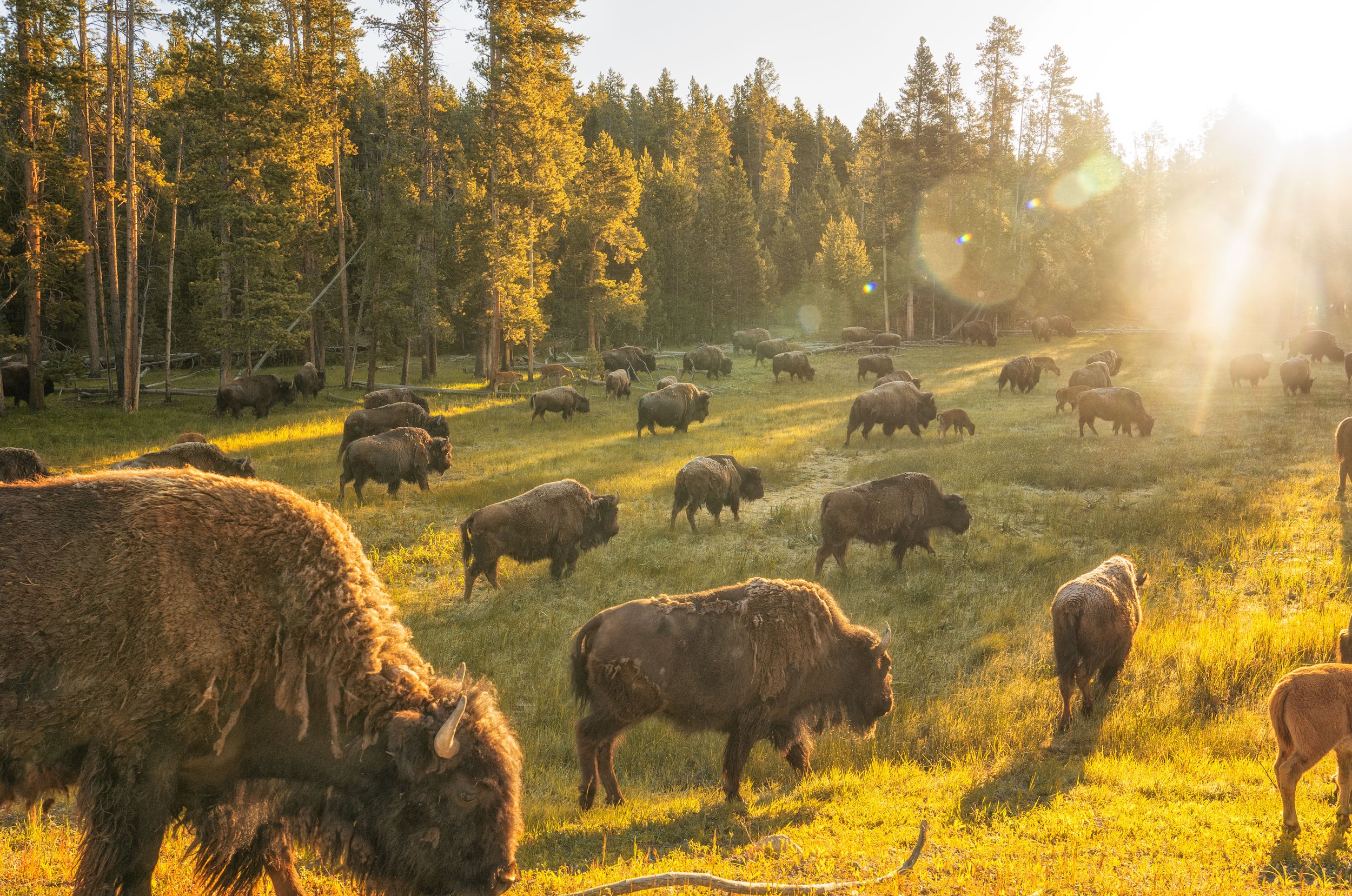
A bison herd crossing into a meadow near Nez Pearce Creek.
“The Lakota world did end at the Little Bighorn because of the [US] government’s intent to end it...[b]ut that day was the culmination of any number of days that might have been the beginning of the end over the course of several generations. It might have been the day the French [voyageurs] first laid coveting eyes on the northern plains, or the day...William Clark’s angry suggestion to force the Lakota into dependence on the government’s will. Or perhaps it was the discovery of gold...or any days a peace talker drafted a treaty that was more favorable to his side. Or the day ethnocentric arrogance declared the West to have land free for the taking.”
“The increasing tendency to redefine America’s mission in secular rather than sacred terms made little difference in regard to antipathy toward wilderness. Insofar as the westward expansion of civilization was thought good, wilderness was bad. It was construed as much a barrier to progress, prosperity, and power as it was to godliness.”
The year was 1870. It was a late August morning and two men had just come across a magnificent flow of water plunging down a massive shelf of basalt rock. “Nothing can be more chastely beautiful than this lovely cascade,” Gustavus Cheney Doane would later write in his journal, “hidden away in the dim light.” The next day other members of the exploration party would attempt to measure the height of this newly discovered waterfall, with estimates ranging from 105 feet to 115 feet. Tower Fall became the eventual choice of name for this impressive cataract, likely because it belonged to the object of infatuation of one of the explorers. It was a moment of admired beauty in this otherwise grim and sometimes harrowing one month sojourn. Soon the committee would be faced with more grotesque examples of volcanically formed statuary, steaming geysers and sulfurously-scented pools that would conjure darker and more diabolical visions as they descended deeper and deeper into the unmapped regions of the Upper Yellowstone. Names such as “…Devil’s Hoof…Devil’s Slide…Devil’s Den, Devil’s Thumb, the Devil’s Cut, the Devil’s Kitchen…” were affixed to all manners of natural formations. Later a yellow/greenish spring (possibly the Norris Geyser Basin?) was compared to the witches’ cauldron in Macbeth and aptly named “Hell-Broth Springs.” Perhaps they had exhausted every variation involving old Scratch himself but weren’t ready to leave the infernal imagery completely behind.

The Fountain Paint Pots, one of the more “infernal” sites in Yellowstone National Park
In his superb book Empire of Shadows: An Epic Story of Yellowstone, George Black recounts the circumstances which led to the 1870 Washburn-Doane-Langford expedition, the first of two scientific explorations into one of the last unmapped regions in the United States. (A privately funded endeavor, the Cooke-Folsom-Peterson expedition, had occurred the year before but the leaders of the group were unsuccessful in convincing national outlets to publish the exploits of the journey. Their journals did serve as inspiration for the 1870 trip.) He begins with the famous 1804-1806 Corps of Discovery led by Meriwether Lewis and William Clark. They passed up the opportunity to enter the Yellowstone basin at the modern day town of Livingston, Montana, though they would not have been the first white men to have seen the fantastic and phantasmagoric phenomena. French fur trappers had already reached the Teton Mountains (Les Trois Tétons meaning the “Three Breasts” in French) and beyond, and it was stories from these same voyageurs that sparked Clark’s interest prior to the launch of the Corps’ journey. Yet for unknown reasons Clark did not actually follow the Yellowstone River into the caldera itself. John Colter, a member of the Corps, later returned in 1807 to scout out fur-trading routes and brought information about the territory that Clark later purposed for his 1814 map of the region, though little is known about how much Colter contributed due to his illiteracy and penchant for spinning yarns. Literary legends attached to him further muddied the picture, thanks to the writings of Washington Irving, who in his 1837 story The Adventures of Captain Bonneville coined the term “Colter’s Hell.” Irving had conflated Colter’s encounter with a thermal region on the Shoshone River with later accounts of geysers and mudpots in the heart of the caldera. “All this nonsense is long discredited,” writes Black, “but creation myths are tenacious things, and casual journalists continued for decades to equate Colter’s Hell with Yellowstone.”
By the early 1800s, the Western frontier had gained a mythic status in the collective imagination of the United States, a giant tapestry of tall-tales with larger than life personas seeking oversized dreams of glory. Led by fortune hunters and mountain men such as Jim Bridger and Hugh Glass (of The Revenant fame), fur-trading companies were competing to establish networks first to procure beaver pelts for fashionable European markets and then later buffalo hides for robes and various other household and industrial uses. The overhunting of the massive ungulates led to a rapid depletion of their population, driving Native peoples further west beyond the Mississippi and Missouri River valleys in the hopes of finding herds to sustain their existence. The most prominent of these groups was the Lakota (Sioux), who had become a formidable presence due to their large numbers and cultural and climate adaptability, moving from the colder winter environs of the upper Minnesota River Valley to the Central Plains almost a century before. They were also shrewd diplomats and expert commercial traders, forging economic ties first with the French and then the British but largely avoiding direct conflict as both sought territorial power in the New World. In addition, various small-pox epidemics in the 1830s devastated the Mandan, Arikara, and Assiniboine peoples, while the Lakota had benefitted from a large scale frontier vaccination campaign thanks to the United States government and were thus faced with weakened tribal competition in their quest for regional supremacy.
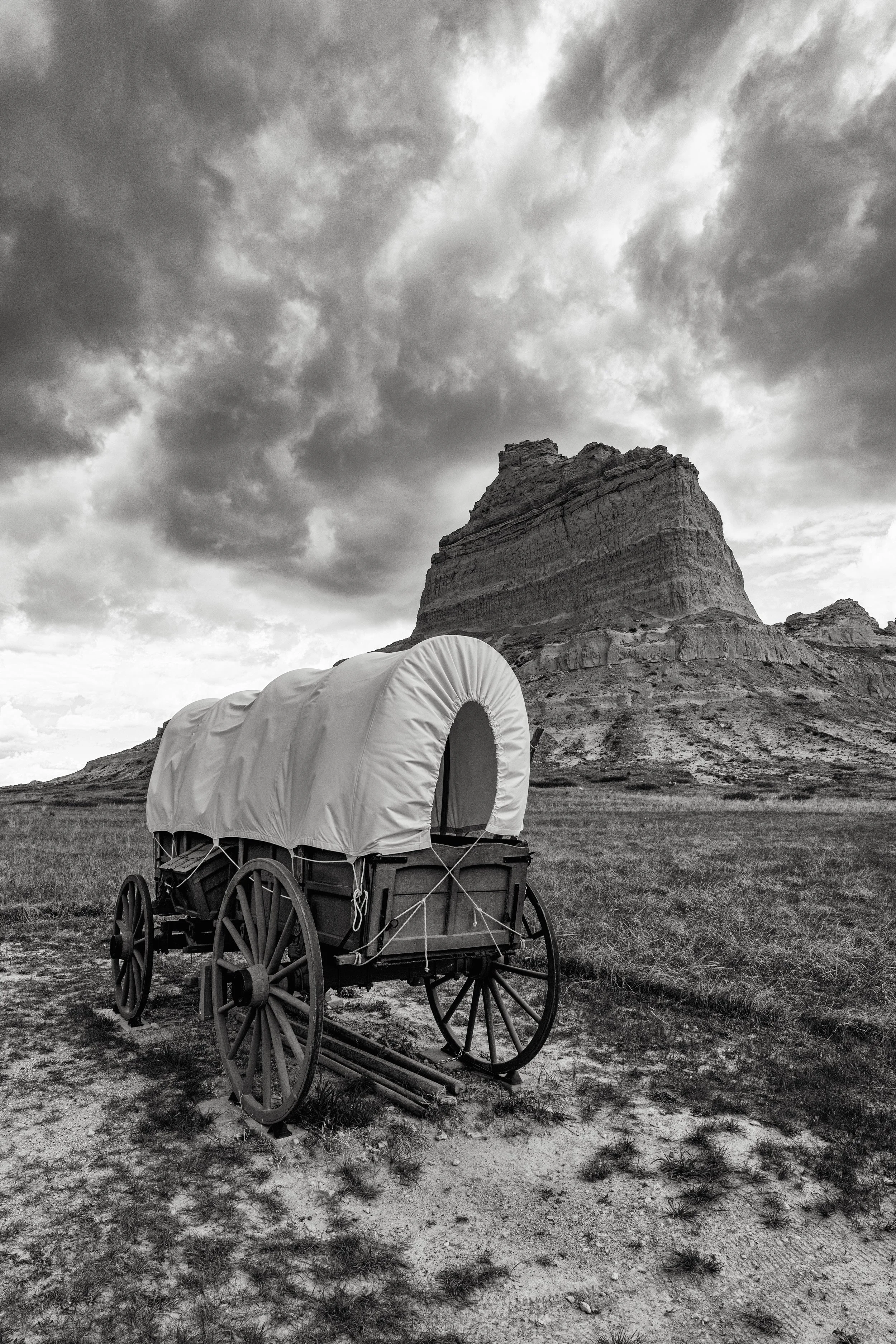
Scotts Bluff National Monument near Gering, Nebraska along the Platte River Valley. Many of the ruts left by overlanders on the Oregon Trail can still be seen throughout the area.
By the end of the 1840s, however, things had come to a head. Three important events helped exacerbate the tensions among the indigenous groups vying for access to the Central Plains and the wašíču (white/non-indigenous person in Lakota) seeking to make inroads in their quest for both economic and civilizational conquest. First, the Mexican-American War (1846-1848) kept the US military fully engaged, allowing the Lakota coalesce into a regional superpower and extend its reach deeper into the Platte River Valley; second, a deadly bacterium brought by overlanders on the Oregon Trail quickly spread among the Lakota and other native groups, fraying the already strained ties between whites looking to obtain provisions for their long journey and the Indian groups looking to profit from the exchange; and third and perhaps most significant involved the discovery of gold near Sutter’s Fort in present-day Sacramento, California, just nine days after the signing of the Treaty of Guadalupe-Hidalgo in 1848 ending the War. The Gold Rush would follow in 1849, and soon what started as a few thousand people passing through the Plains quickly became several hundred thousand and helped fast-track the state’s bid for statehood in 1850.
Desperate to impose order, the United States government began establishing military forts along overlanding routes, many in the same locations as the fur trading outposts founded by the French and British, both to provide frontier security and serve as reservation agency offices. It was near Fort Laramie in 1851 at the mouth of Horse Creek, Wyoming, where US federal agents hosted the largest gathering of Plains Indian communities such as the Lakota, Yanktons and Yanktonais to address these emerging problems. In his magisterial Lakota America: A New History of Indigenous Power, Pekka Hämäläinen describes in great detail how this desire to seek a resolution in actuality revealed a deepening divide between their perceived positions. While the Indian Affairs officers hoped to persuade the natives into accepting life on a reservation as a means to ensure their safety (and also to make them more culturally malleable), the Lakota had decidedly different plans. As Hämäläinen writes:
“It was a vision as ambitious as it was myopic. Gazing across the Pacific past the Indians, the federal agents failed to identify the most immediate obstacle to their grand design. The Lakotas whom they tried to pacify…also thought in terms of large-scale geopolitics, and, like Americans, they had grown to command the world around them like an imperial power…Lakotas would follow the bison…and would not heed some lines on a map…[they] demanded the central plains all the way south to the Arkansas [River]…[and] [t]hey did so by the right of conquest.” (p. 218)
The Horse Creek Treaty of 1851 ultimately failed because of the Lakota’s refusal to allow their hunting rights to be circumscribed and their decentralized tribal organization to be compromised, and for the next three years hostilities escalated as promises of substantial annuity payments in exchange for territorial concessions were broken and the terms of the treaty were violated by both sides. In 1854 the Grattan Fight became the slow fuse that eventually lit the powder keg of what would be known as the Sioux Wars, beginning in 1862 in present day Minnesota. Even though the US military would eventually crush the Seminole revolts in Florida in 1858 and the Comanche in 1875 after an eight-year campaign, they were completely unable to subdue the Lakota until the Battle of Wounded Knee in 1890 and the death of Sitting Bull just two weeks before.
The main reason for the Lakota’s survival, in Hämäläinen’s words, involved their mastery of “shapeshifting,” a peculiar ability to transmute depending on the exigent circumstances and strategic aims. When it was necessary to seek an ally, the Lakota would pursue conciliation instead of conflict with other tribes. When confronting overwhelming numbers in battle against the US military, the Lakota would conduct guerrilla campaigns using rearguard tactics, knowing they could retreat to a safe distance due to their intimate knowledge of the landscape. When they wanted to strike fear, establish territorial leverage or exploit their tactical advantages, the Lakota would disrupt the provisioning of garrisons by attacking supply lines or raid vulnerable overlanders along the Oregon Trail as arbitrary reminders that they held the key to safe passage.
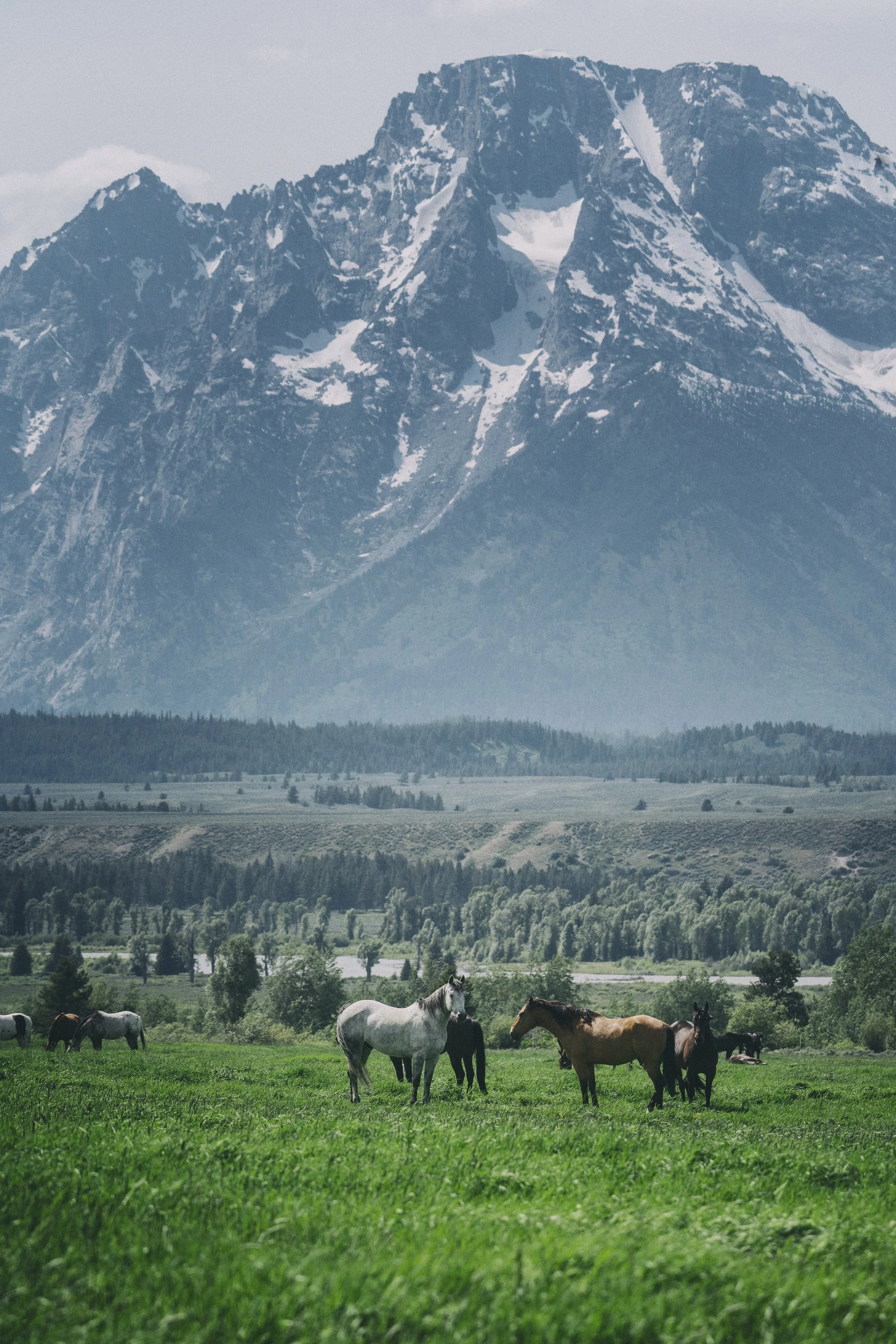
Horses grazing in the Grand Tetons.
Though these asymmetric methods were effective in disorienting the military for a period of time, in reality they were incredibly taxing to sustain. The nomadic lifestyle of the Lakota was heavily dependent on locating abundant sources of water and grasslands for their horses and where they would most likely find bison to hunt. Unfortunately, a succession of droughts, harsh winters and aggressive hunting by settlers along the Platte River valley drove them to the brink of poverty, and when another vein of gold was discovered in the Rocky Mountain foothills in 1858, many of the Lakota chieftains who had not been constantly besieged began to take into account the considerable toll shapeshifting was exacting on their people.
The United States was also at a crucial juncture. The passage of the Homestead Act in 1862 and the end of the Civil War in 1865 found the US poised to complete its vision of Manifest Destiny, whether through the violent removal of the remaining indigenous peoples or negotiating peace treaties to drive them onto reservations. After reaching a stalemate at Red Cloud’s War near Bozeman, Montana in 1868, the United States finally relented, realizing that their economic interests were going to be continually thwarted until they agreed to the Second Treaty of Fort Laramie that same year. In exchange for the establishment of the Great Sioux Reservation in the Black Hills and decommissioning of some of their forts, the United States would finally have clear passage into the Yellowstone valley for the eventual completion of the transcontinental railroad, though it should be noted that only some of the Sioux agreed to life on the reservation. Two notable exceptions were the northern Lakota, led by Sitting Bull (Tȟatȟáŋka Íyotake) and Crazy Horse (Tȟašúŋke Witkó), who preferred to preserve their nomadic traditions and cultural autonomy.
The 1870 expedition came during a brief window of detente, though in retrospect it was more of a tipping point where the balance of power was now most assuredly shifting towards the United States. The influx of Swedish and German immigrants in the territory of Minnesota precipitated the almost complete displacement of the Dakota (a member nation of the Sioux) in the early 1860s, and with additional victories over the Cheyenne and the Arapaho in the Sand Creek Massacre in 1864, the US military appeared to gain the upper-hand as the end of the decade approached. In 1859, a small exploration party led by Captain William Raynolds sought passage to scout the Yellowstone region for white settlement and railroad development. At the time it was a bold move, considering that the Lakota claimed dominion over the Black Hills and warned of the dangers of cutting right through the heart of their territory. “Lakota chiefs advised Raynolds to follow the Missouri to the Yellowstone [River] confluence, effectively skirting the Lakota territory,” Hämäläinen writes, but the Captain warned that if denied, “the President would send soldiers to wipe out the entire nation from existence.” (p. 246)
Sadly these pronouncements would prove prophetic, though it would take another 30 years for them to come to fruition. In the meantime, the Lakota and the US Military were engaged in a battle of words, posturing as imperial powers, with each side desperate not to reveal their shortcomings as they sought to project an image of strength and resilience. Thomas Twiss, an Indian Agency Officer, understood the gap between rhetoric and reality on both sides, and he submitted a report around the time of Raynolds’ journey to educate his superiors. “The state of the Indian mind among the wild tribes is one of extreme suspicion in all matters relating to the preservation of game, their only means of subsistence,” he wrote. Twiss was entreating the United States to show compassion to the Lakota, using language that he thought would resonate with their worldview:
“This process of development, this law of Anglo-Saxon progress, is a necessity and consequence of, and flowing directly from, our free institutions, which, in their strength, purity and beauty, tend to stimulate and bring forth the vast resources of agriculture, mineral and commercial wealth, within the boundaries of our great empire…[we should persuade the Lakota] to settle cordially in reservations, and devote themselves to labor for their own subsistence.” (p. 250)
Twiss’s observations were accepted as a foregone conclusion. Of course the Lakota needed to settle in reservations, but if they didn’t understand the (ever changing) terms of the treaties they were agreeing to, they would be made to learn them in the harshest possible terms, including wholesale extermination. In the wake of the Marias River Massacre in January, 1870, public outcry forced the Grant Administration to ramp up enforcement of their “Peace Policy” reform in which they would continue to encourage more agreeable natives to move onto reservations by plying them with goods and offering support for adopting Christianity and homesteading. Once gold was discovered in the Black Hills in 1874, however, all bets were off and the US Cavalry was once again called to began forceable removals and direct military engagement if necessary. Little Big Horn would follow two years later.
The Washburn-Doane-Langford expedition lasted for roughly 34 days, during which time they would continue from Tower Fall and eventually make their way around Yellowstone Lake and head west towards Old Faithful, the Upper Geyser Basin and follow along the Madison River towards the town of Virginia City. Along the way they would lose a member of the party (Truman Everts, who was essentially left for dead but would be found over a month later), come perilously close to running out of rations, and endure the declining health of the group’s leader, General Henry Washburn, who would die just a few months after the conclusion of the journey. One of the main reasons why this expedition would gain national prominence (instead of the 1869 or even the 1858 excursions) was the growing hunger for travelogues among the reading public, fueled by dreams of transcontinental railroad travel and an emerging narrative largely free of the indigenous threat. Nathaniel Langford would publish a sensational account in Scribner’s Monthly, one of the most popular magazines of the day, and Gustavus Doane would follow with an in-depth report that would find widespread distribution.
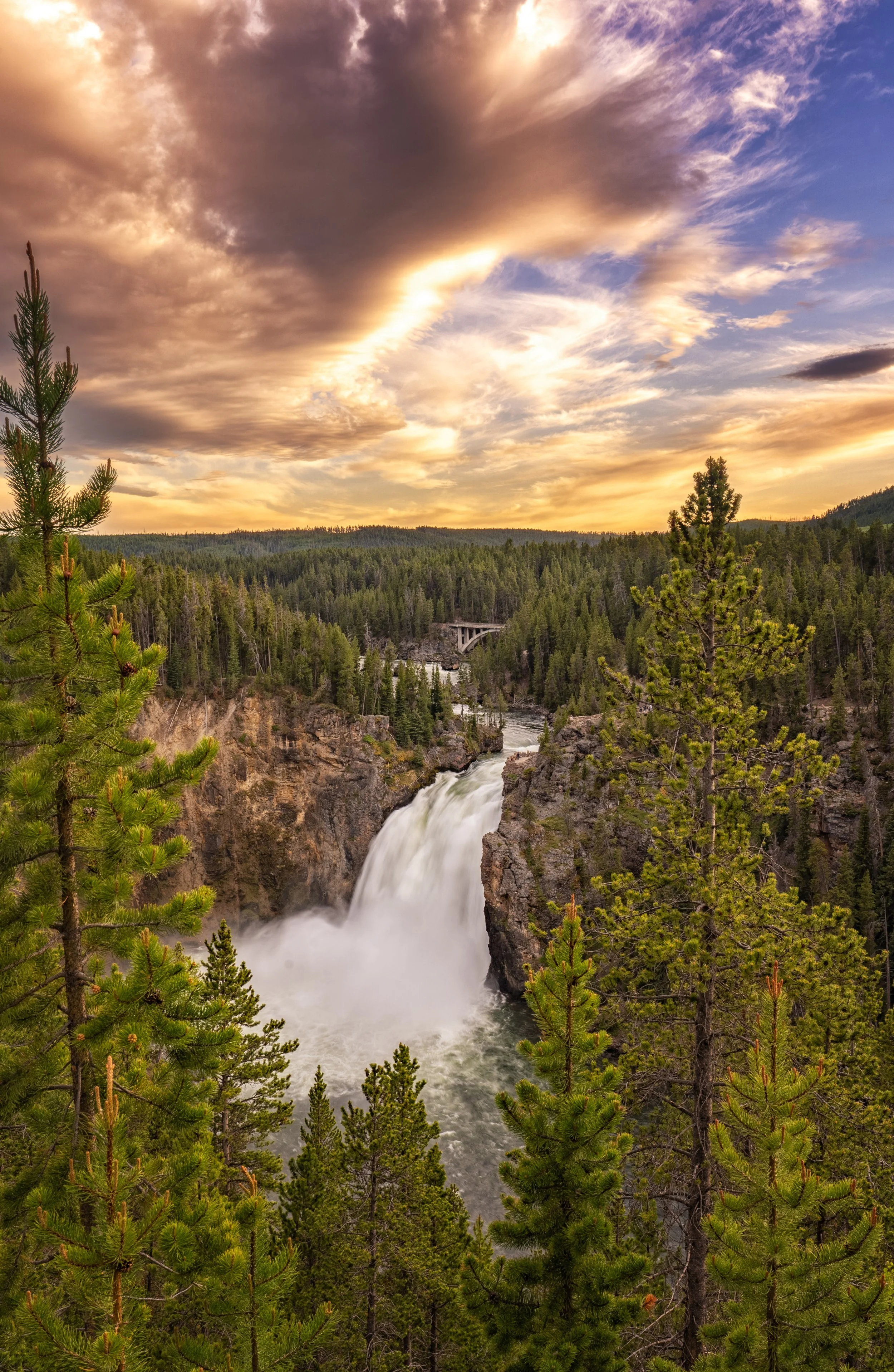
The Upper Falls of the Grand Canyon of the Yellowstone
Both would use ideas and language that were reflective of their Victorian-era conception of the wilderness, “…a fine line between the sublime and the diabolical” as Black describes it. “We feel that we have been near the presence of the Almighty,” Langford would write in his journal. “I can scarcely realize that in the unbroken solitude of this majestic range [the Grand Canyon of the Yellowstone]…away from civilization and almost inaccessible to human approach, the Almighty has placed so many of the most wonderful and magnificent objects of His creation.” Doane would appeal to the caves of Aladdin and fairy-like images that would be well-known to the imaginations of his 19th century readership. Neither gave much consideration as to how the Indians saw these hallowed lands, appealing to their own understanding of Christian theology in speculating that the natives’ savagery was only superseded by their superstitious nature. “I would rather suppose,” wrote Walter Trumbull, another member of the party and a respected writer in his own right, “[the Indian] would give [the thermal features] a wide berth, believing them sacred to Satan.”
The Lakota did assign sacred meaning to the Yellowstone, but of course not in the terms defined by Trumbull or Langford. “To the Lakota, the earth was alive because it was the source of life,” writes Joseph M. Marshall, a Lakota historian and descendent. “As such it was more than a symbol for mother; she was the mother of everything that lived and moved…she provided for all her children. When the Lakota prayed, the earth was called Grandmother.” Marshall goes on to say:
“Prayer was part of the everyday life of the Lakota long before the arrival of Christianity, and prayers could be said or offered anywhere. The idea that God lived only in a certain place or could be approached only from a specific location was foreign to Lakota people. To them, God lives in all things and hears our prayers from anywhere they are prayed.” (p. 186)
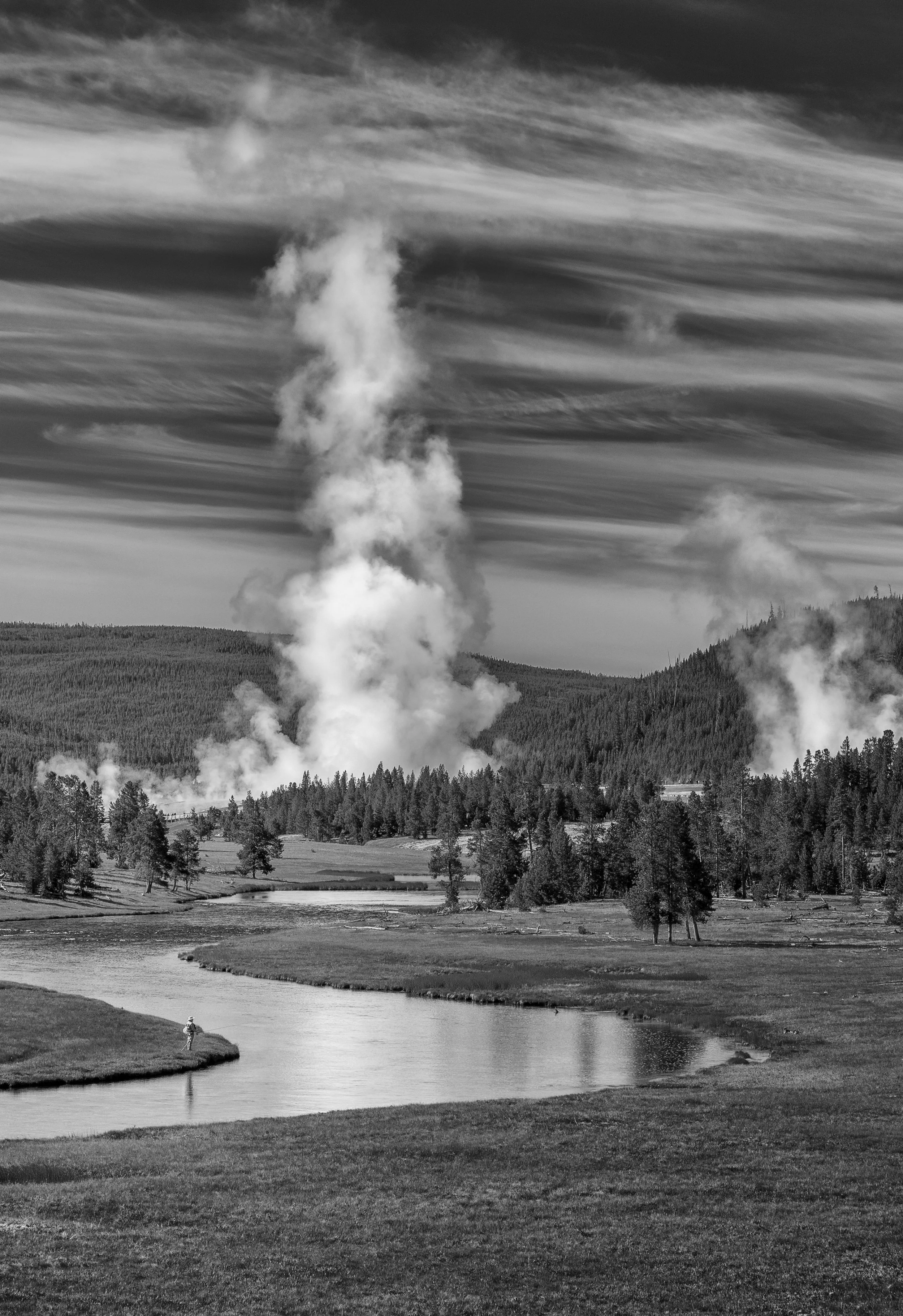
A lone fisherman casting his luck on the Firehole River just north of the Grand Prismatic Spring.
The Hayden Scientific Expedition followed in 1871, carrying out more in-depth geological studies of the area, but its greatest historical legacy involved convincing the United States Congress to declare Yellowstone a national park in 1872, the first in the country and eight years after Yosemite Valley in California had become federally protected land. Although relatively few white people visited for recreation in the ensuing decade, once the Union Pacific completed its rail line through the northern entrance of Gardiner, Montana in 1883, tourists began visiting the region and staying at the newly constructed National Hotel (now Mammoth Springs Hotel). A mere seven years prior, the United States Cavalry had been routed at the Battle of the Little Big Horn (or the Greasy Grass, as it is known in Lakota history), and despite news of the debacle spreading quickly, it evidently did not dissuade enterprising hucksters, well-heeled East coasters, and even wealthy European tourists from making the arduous trip, safe in the knowledge that the indigenous presence was now almost eradicated.
Over the ensuing years, the United States government sought revenge for the loss at Little Bighorn, pursuing a course of systematically depriving the Lakota of their lands while maintaining the pretense of looking after their welfare. Congressional acts in 1877 required the Lakota to relinquish their territory outside of the Great Sioux Reservation, and the General Allotment Act of 1887 (also known as the Dawes Severalty Act, named for Senator Henry Dawes) gave President Cleveland authority to break up tribal lands into single parcels of ownership, imposing Americanized ways of subsistence farming and ranching on the beleaguered natives. At the same time, Lakota children were involuntarily removed to distant boarding schools for the next 90 years in a campaign of forced assimilation and cultural erasure. The hegemony of the United States was complete and the Lakota would be consigned to living in near peonage and subservience for the foreseeable future.
In 1893, the city of Chicago hosted the World’s Columbian Exposition in recognition of Columbus’s 1492 arrival in the New World. During the event, Frederic Jackson Turner, a preeminent historian from Wisconsin, gave a lecture entitled “The Significance of the Frontier in American History.” He expounded on what became known as the “Frontier Thesis,” the apotheosis of Manifest Destiny whereby the “triumph of the frontier” led to the transformation of representative democracy through the emphasis on rugged individualism and self-determination. Turner writes:
“The existence of an area of free land, its continuous recession, and the advance of American settlement westward, explain American development. Behind institutions, behind constitutional forms and modifications, lie the vital forces that call these organs into life and shape them to meet changing conditions. The peculiarity of American institutions is, the fact that they have been compelled to adapt themselves to the changes of an expanding people to the changes involved in crossing a continent, in winning a wilderness, and in developing at each area of this progress out of the primitive economic and political conditions of the frontier into the complexity of city life.”
Turner concludes the lecture by drawing a comparison to Ancient Greece, perhaps to suggest that the United States would emulate a similar path to renown and reach a new stage in its evolution:
“What the Mediterranean Sea was to the Greeks, breaking the bond of custom, offering new experiences, calling out new institutions and activities, that, and more, the ever retreating frontier has been to the United States directly, and to the nations of Europe more remotely. And now, four centuries after the discovery of America, at the end of a hundred years of life under the Constitution, the frontier has gone, and with its going has closed the first period of American history.”
The lecture was well-received and would prove highly influential in American thought for the next several decades. It was a work of deliberate myth-making that perfectly aligned with the Exposition’s mission to celebrate the 400th anniversary of the “discovery” of the New World, extolling the progress made while minimizing the impediments as necessary bumps along the road to civilizational maturation. The issue of slavery, for example, which had roiled the country for the better part of the 19th century up to that point, would receive only a token acknowledgment in Turner’s essay, downplayed as a “struggle” or “question” that was merely a “sectional issue” destined to be overcome. Reconstruction wasn’t even referenced, either directly or by implication.
What was also almost ignored—much like the Taino Indians and their fate in the prevailing narrative of Columbus—was the effect on the indigenous world. Despite Wounded Knee occurring a mere three years prior, Turner included only two brief mentions of “Indian Wars” which the United States “won” in the Far West.
No individual indigenous group—not even the Lakota—were mentioned by name.
The Final Part Coming soon!
Sources Used:
George Black. Empire of Shadows: The Epic Story of Yellowstone. St. Martin’s Griffin: 2012.
Pekka Hämäläinen. Lakota America: A New History of Indigenous Power. Yale University Press: 2019.
Joseph M. Marshall III. The Day the World Ended at Little Bighorn: A Lakota History. Penguin: 2007.
Roderick Frazier Nash. Wilderness and the American Mind. (Fifth Edition). Yale University Press: 2014.
Megan Kate Nelson. Saving Yellowstone: Exploration and Preservation in Reconstruction America. Simon and Schuster: 2022.
Nathaniel Philbrick. The Last Stand: Custer, Sitting Bull, and the Battle of the Little Bighorn. Penguin: 2010.