
On the Joys of June Appal
One of the great historic archives of Appalachian music is now available digitally for the first time
I opened my email last week to an exciting announcement:
“Hello June Appal listeners,
We are excited to present (almost) all of the historic June Appal Recordings, now available for download on Bandcamp as pay-what-you-want.
This release is part of a broader effort to make accessible the vast holdings of the Appalshop Archive. Many of these June Appal Recordings have previously only been available in limited quantities of physical stock, and are appearing here in digital format for the first time…”
Appalshop
June Appal Recordings is a division of Appalshop, the non-profit arts organization established in 1969 in Whitesburg, Kentucky. The idea behind Appalshop was to provide a counterpoint to the prevailing media narratives during the era of Lyndon Johnson’s Great Society and specifically the War on Poverty.
In 1964 CBS aired the television special “Christmas in Appalachia” hosted by Charles Kuralt of numerous “On the Road” segments and later of “CBS Sunday Morning” fame. In this thirty minute program Kuralt explored the roots of poverty throughout Eastern Kentucky and helped bring the plight of the coal camps to the popular consciousness of Middle America. It was followed by another special in 1968, Appalachia: Rich Land, Poor People, produced by National Educational Television (NET), a precursor to the Public Broadcasting System, which again focused on the lives of the downtrodden but resilient residents of Eastern Kentucky and West Virginia. However, many felt that these attempts—while well-meaning—were essentializing in nature, reducing denizens to helpless victims and reinforcing stereotypes as communities lacking in agency not only with regards to their economic status but also in terms of cultural expression.
Interestingly, it took a New York-born, Indiana-raised and recent Yale University graduate, Bill Richardson, to capitalize on the growing media attention to Appalachia with a grant from the Johnson administration and the American Film Institute and start Appalshop a year after the NET special. Richardson had a background in documentary filmmaking (he had one finished film under his belt) and with the widespread availability of affordable film and sound recording devices such as the Bell & Howell 16mm camera (highly valued by US news organizations for its portability during the escalating Vietnam War), he saw an opportunity to bring together local youth and artists to document their communities through their own eyes. Though Appalshop began with a focus on filmmaking, it would soon branch out to include photography, theater and other forms of media. Music production would follow five years later.
June Appal
"We started in a time and a place of rebirth in the Appalachian region,” states Jack Wright in a mid 70s radio interview with the well-known Kentucky author Gurney Norman. “Of course Appal standing for Appalachian…but June Apple was an old time fiddle tune, so we just took the name from that.” Wright founded June Appal Recordings in 1974, and was a musician in his own right, with both him and Norman (who sadly passed away last year at the age of 88) producing albums for the label.
Wright adds:
"June Appal started with the idea that we would try to promote and try to, um, not necessarily preserve that which was going on, uh, but try to make the link - the ongoing process, the artistic process - of ongoing things like father to son or old timer to the younger people…It's - it's an ongoing tradition, and that's what we want June Appal to be is something that's not just preserving the past but is an ongoing reality…And I know it must be great um, uh, must have been great for, uh, musicians from around the region to suddenly realize that they had access, a, a resource, that these young people over in Whitesburg, uh, had a studio, uh, that was actually dedicated to them musicians here…what we're doing is just trying to record people that are trying to make a living in music who are finding it hard, it's, uh, a real rough road either way you go, real commercial or grass roots or whatever. Uh, it's a real predicament. It's hard work to make a living as a musician or any k- almost any kind of artist in, in the mountains.”
The label would go on to produce nearly 100 albums from artists throughout the Appalachian region and the greater diaspora. Luminaries such as folk legends Jean Ritchie and Lily May Ledford, influential civil rights activist and songwriter Si Kahn, and Prairie Home Companion stalwarts Robin and Linda Williams would appear on the label, as well as more recent artists Brett Ratliff and The Local Honeys. I’ll highlight a couple of the lesser-known gems a little later in this post, but first, a bit of backstory of how I discovered June Appal and the specific artists who inspired my love of Americana, Irish and other traditional forms of music.
Malcolm and McCutcheon
I was familiar with Appalshop from my days teaching film studies at the Governor’s Scholars Program (GSP), when I had invited a couple of filmmakers who had produced work through the organization to come to speak about their projects to my students. But I came to the June Appal label in a more roundabout fashion.
During my college years I had fallen in love with the Windham Hill label (don’t worry, I’m not changing directions in this blog), especially with their early Winter Solstice releases. On the first compilation is a beautiful piece on hammered dulcimer called “Northumbrian Lullaby” by the artist Malcolm Dalglish, and on the second is a piece entitled “This Rush of Wings” by the group Metamora. Now, being that this was the early 90s, it was hard to find information on these two artists, but instinct told me that there must have been some connection. I also noted that on George Winston’s acclaimed December album was a piece called “Minstrels,” inspired by the song “St. Basil’s Hymn” by one…Malcolm Dalglish!
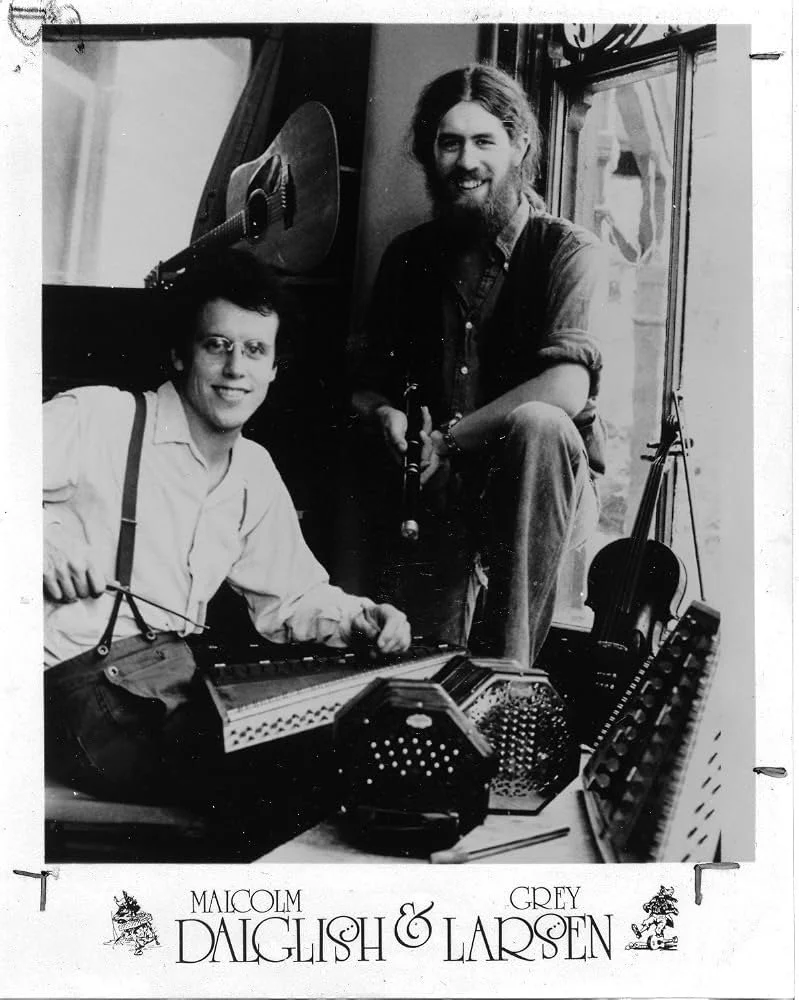
A promotional image of Dalglish and Grey Larsen, date unknown, though probably around or just after the Thunderhead album in 1982.
From there it became a mission to track down any and all work by this amazing musician, which led me to two albums found in a used record bin at Phil’s Records, a local music shop here in the Northern Kentucky area: Banish Misfortune (1977) and The First of Autumn (1978), both with the multi-instrumentalist Grey Larsen and released by June Appal Records. The duo then moved on to the Flying Fish label and recorded Thunderhead (1982) before teaming up with the fiddle player Pete Sutherland to form the trio Metamora and record their most successful album, the self-titled Metamora in 1985 for Sugar Hill Records.
Their repertoire was a mix of traditional American and European folk music and Irish dances, jigs and reels, innovatively arranged and performed with Dalglish’s cutting edge technique on the dulcimer serving as the heartbeat of their performances. All three would add original vocal compositions as well (see my photo below), including the song “Little Potato,” which became a minor hit due to its rotation on NPR. The group would record two more albums, The Great Road (1987) and Morning Waltz (1988), the latter on the Windham Hill label, before they would go their separate ways. Each also recorded a number of solo albums, all of them highly cherished by me. (See the end of this blog for a partial discography).
Today Grey Larsen records and tours mainly with singer/songwriter Cindy Kallet, while Dalglish has kept a low profile since venturing into the world of choral work in the early 90s with his most ambitious composition Hymnody of Earth (1991) based on the writings of famed Kentucky author Wendell Berry. Sadly, Pete Sutherland passed away from cancer in 2022, but not before recording several more albums and leaving behind a legacy of education and civic service in his native Vermont.

My photo from Gunnison National Forest near Crested Butte, Colorado, entitled “The Way Nature Paints.” The multi-colored aspens reminded me of a box of paint brushes dripping with color, so it seemed natural to borrow the title from one of my favorite songs on the album Metamora, “The Way You Paint/Narnia” (Lyrics: Dalglish/Music: Larsen). It is sung by Dalglish, with Larsen and Sutherland layering in their beautiful harmonies. This photo was published in the Fall 2018 issue of the magazine Outdoor Photographer, a true thrill for me!
Another inspiring artist who began on June Appal is the magnificent dulcimer/multi-instrumentalist, John McCutcheon. After I had exhausted my search for all things Dalglish, I stumbled across McCutcheon’s second album for the label, The Wind that Shakes the Barley (1977), while rifling through the stacks at my neighborhood library. A return trip found me checking out all of the remainder of his inventory there, mostly his children’s albums recorded for the Rounder Music label, and subsequent visits to my local record stores helped me locate more of his work. His first outing for June Appal, How Can I Keep From Singing (1975), was the third album recorded for the label and much harder to locate—until now! Little did I know at the time that McCutcheon and Dalglish were both acolytes of Guy Carawan, a popular folk artist and musicologist of the 50s, 60s and 70s, who helped popularize the protest anthem, “We Shall Overcome,” and who helped introduce the dulcimer to a wider musical audience. (Carawan would also record a couple of albums for June Appal). Eventually McCutcheon and Dalglish’s paths would cross many times over the years, both in the studio and on tour.
McCutcheon is still going strong at age 74 and just produced his 45th album. His musical livestreams really helped my wife and me get through the pandemic, and he has archived them at his website. You should really check them out!
Hidden Gems
Unless you are steeped in the vast panoply of Appalachian music traditions, it can be daunting to know where to start with the June Appal label, and goodness knows I am not fully conversant. Here are three albums/musicians that I discovered after coming across the artists I mentioned above.
Before moving to Northern Kentucky, I was only vaguely aware of the Appalachian diaspora in the Greater Cincinnati and Southwestern Ohio areas. My wife’s side of the family all hail from West Liberty in the hills of Eastern Kentucky, though many had migrated to places such as Fairborn, Middletown and Dayton in search of employment while returning home almost every weekend. Some of the artists who recorded for the label came from or were connected to this cultural migration (also known as the Great Exodus), including both Dalglish and Larsen who met at Oberlin College and began playing at various pubs in the Cincinnati area in the mid 1970s. These gigs were fertile ground for them to connect to other traditional musicians plying their trades in and around downtown. One artist was Michael Kennedy, a melodeon player from County Galway in Ireland but who resided in Covington. He had been a fount of musical knowledge for them in recording both Banish Misfortune and The First of Autumn, and his own album 65 Years of Irish Music is a great place to start to acquaint you to the influence Irish music had on early Appalachian musical traditions.
Another artist who could be called a “musician’s musician” is Thomas Hal (Tommy) Hunter, a fiddle player from North Carolina. Accompanying him on guitar on the album was John McCutcheon, who cited Hunter as the source for songs on several of his albums. He paid respect to Hunter in the liner notes of How Can I Keep From Singing?
“Tommy is the finest hornpipe fiddler I’ve ever heard—a meticulous musician whose love and respect for the tradition of the old time fiddling he learned from his grandfather is evident in each note he pays.”
Hunter was hugely influential on many artists from the North Carolina region and beyond. He didn’t leave behind many albums, so this is the best representation of his style of playing. (NOTE: There is another Tommy Hunter from Canada who also played fiddle and hosted a very popular country music show in Canada, so don’t get confused!)
Finally, an album that I’m going to recommend is the live recording of the Seedtime on the Cumberland Festival from 1991. Every year Whitesburg hosts this 3 day event at the beginning of June, and this year was extra special not only because it was the 40th anniversary, but it was the first time since the devastating floods of 2022 that visitors were allowed to return to the Appalshop headquarters. This album is a perfect introduction to the bluegrass, folk and traditional mountain music that the label was created to document. (There are two other Seedtime compilations available as well.) Catalog artists Jean Ritchie, Kay Justice and Ginny Hawker and others are well-represented here, but I want to single out two in particular: the First Lady of West Virginia Gospel music, Ethel Caffie-Austin and her performance of the Gospel tune, “Listen to the Lambs”; and the Cherokee Indian and Tennessee-born performer Walker Calhoun and his two pieces, “Corn Dance” and “Eagle Dance.” Their inclusion help to shed light on these underrepresented musical subgenres and expand our understanding of what constitutes the Appalachian experience.
I should also note that Appalshop has done a tremendous job over the years filming the Seedtime Festival and you can watch many of the performances from 1991 (including a more expansive set from Walter Calhoun), as well as this year’s entire set of performers from their YouTube channel. (I couldn’t find Caffie-Austin’s performance from 1991, so instead here is the superb 1999 documentary short His Eye is On the Sparrow from Appalshop about her as the music minister of a church in Charleston, West Virginia.)
Of course the exciting thing about this announcement is the opportunity to explore the entire June Appal catalog and discover this wonderful music for yourself! I’ve posted a few more albums below that I have really enjoyed, but to see the complete collection, hop on over to their Bandcamp page and start an account—it’s free to join the platform. All of their available back catalog (albums prior to the mid 2010’s) are available for Name-Your-Own price, and whatever you contribute goes to help further the cause of this wonderful cultural icon.
This is the digital compilation of interviews conducted by Nikki Giovanni of several Appalachian women writers, including Barbara Kingsolver, George Ella Lyon and Bobbie Ann Mason. This was not a June Appal release initially but it is available for free from Bandcamp.
Sources Used:
Radio Interview with Gurney Norman and Jack Wright:
“Appalachian Artists: The Younger Generation; An Interview with Jack Wright of June Appal Records (Part 1),” Appalshop, Inc., American Archive of Public Broadcasting (GBH and the Library of Congress), Boston, MA and Washington, DC, accessed August 21, 2026, http://americanarchive.org/catalog/cpb-aacip-138-2259zz1w.
Bill Richardson Interview:
“Bill Richardson, August 14, 2015,” Exploring the Legacies of Appalshop Oral History Project, accessed August 21, 2026, https://www.nunncenter.net/legaciesofappalshop/items/show/2.
“Metamora Picking Old Tunes.” The Washington Post. Accessed on August 21, 2026:
Partial Discography of solo projects of Malcolm Dalgish, Grey Larsen and Pete Sutherland:
Malcolm Dalglish
Jogging the Memory (1984, Windham Hill)
Hymnody of the Earth (1991, Musical Heritage Society)
Grey Larsen
The Gathering (1986, Sugar Hill Records)
The Orange Tree (1993, Sleepy Creek Music) with Andre Marchand
Dark of the Moon (2003, Audio & Video Labs) with Paddy League
Welcome Day (2015, Sleepy Creek Music) with Cindy Kallet
Pete Sutherland
Poor Man’s Dream (1984, Flying Fish)
Mountain Hornpipe (1989, Epact Records) with guest appearances by Dalglish, Larsen, et. al.
Sunday River (2019, No Label) A collection of music composed by Sutherland and performed by various artists