
Meditations on Yellowstone
Part I: Finding our Nature in Nature
In Meditations, Marcus Aurelius writes that it should be in our nature to help other humans as it best aligns with furthering our common purpose on this Earth. In Part I on my mini-series about visiting our first National Park, I share a small moment where I hope to be my best version of being a human.
“Human happiness consists of fulfilling duties specific to human beings. It’s a human duty to act benevolently toward other humans, to scorn the vagaries of the five senses, to discern which sensory impressions are trustworthy, to admire both Nature as a whole and everything going on inside it.”
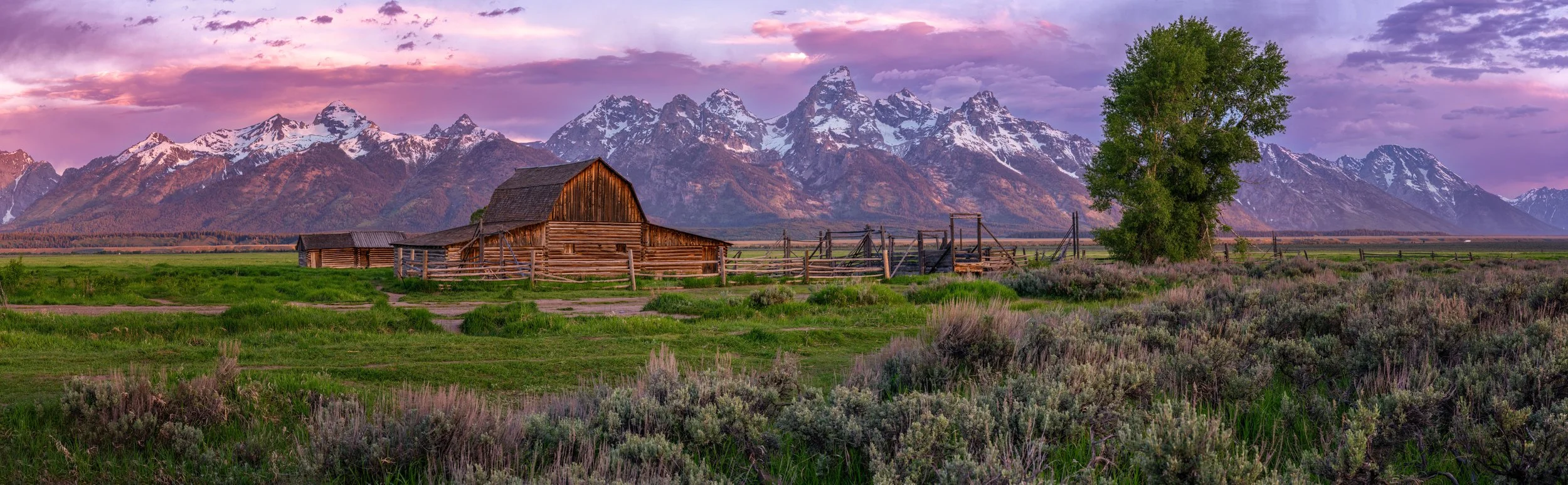
The iconic view of the Moulton Homestead in Grand Teton National Park, Wyoming.
I was the second person to exit my car in the small parking lot adjacent to the John Moulton Homestead in Grand Teton National Park, Wyoming. It was 4 a.m. and I had just returned to this very location only three hours after spending the better part of the evening photographing the Milky Way rising over the iconic barn. I adjusted my headlamp, strapped on my overstuffed backpack and headed out to the sagebrush-strewn field. For the next half an hour I would stumble in the dark to find the perfect position from which to photograph sunrise. Soon I would see the dark forms of other photographers spread out across the landscape, their crisscrossing headlamps resembling the landing lights of the Jackson Hole Airport a mere five miles away next to US 191, the main bypass through the park.
I had just set up my tripod and put my gloves back on to help combat the bite of an unexpectedly chilly June morning when a timid voice came drifting through the air. “I’m sorry to bother you, but would you know anything about how to use this camera?” The sky had now lightened to a deep indigo and I could just make out a short middle-aged woman stepping over a patch of sagebrush, flashing a sheepish smile and holding a giant camera. I was still in the middle of retrieving my gear when she and her husband sidled up to me seeking assistance.
“Sure,” I replied, temporarily blinding her with my still illuminating headlamp. “Just give me a moment to get everything ready.” I hadn’t made eye contact with the couple yet, but I could already sense their relief as she mumbled a soft and slightly apologetic “Thank you.” After securing the intervalometer cable to my camera, I met her pleading eyes and attempted a nod of reassurance. “Let’s take a look at it,” I said. She lifted the camera and held it away from her body as if it were a yapping dog she was desperate for me to take back.
"My father gave me his old camera after he bought a new one, and I have no idea how to use it,” she stammered. “I have it on an automatic setting, I think.” It was a Nikon D800, a powerhouse of a DSLR and a favorite of many a landscape photographer. The only problem was I had no idea how to use it, either, as I have been a lifelong Sony shooter.
“Well,” I answered, gingerly removing it from her hands as if I wasn’t sure it would bite. “I don’t really know anything about Nikons. What are the current settings?”
“Automatic, like I said.”
“No, I mean the aperture, the shutter, the ISO. I think you have LIVE VIEW on the back LCD screen, right?” My question was met with a blank stare. At first I wasn’t sure if I had my Nikonese correct and was immediately beginning to worry that I was just making the situation worse.
Why would her father give her this camera? This is like giving the keys to a Ferrari to a 16 year-old to pick up milk at the grocery.
“I…I don’t know. I’m sorry.” I had heard those words innumerable times as an adult English as a Second Language instructor, and I knew that my next response had to be carefully considered. Or, at least I realized that immediately after I had thoughtlessly blurted out:
“Your father didn’t show you how to use this?”
Way to go, Teach. Shame the student.
She tittered nervously. “No, he just gave it to me right before we came on this trip. I meant to watch some videos, but there wasn’t any time.” I looked over at her husband, who graciously overlooked my blunder. He had been tending to their two sleepy-eyed preteens who were wrapped up in blankets and looked as if they had been dragged out of the car to participate unwillingly in this required family moment of joy.
“We were so excited to come on this trip,” her husband chimed in, his tone achingly earnest. “We’re from Utah and this is our first time here. We really wanted to see the barn.” The tweens yawned in ambivalence.
“Of course,” I said, recovering my composure. What could I do to help here? What would make this a better experience for them? I went with my first instinct:
“Do you have a tripod?”
Great. If she doesn’t know how to use the camera, she certainly wouldn’t have a tripod, genius. Didn’t you used to be a good teacher?
“I do, actually, but I left it at home.”
That’s encouraging. But it doesn’t help us here. I now regretted my entire line of inquiry and searched the ground for any hole to crawl into. Suddenly the solution presented itself.
“Well, I don’t know if I could help you with the camera,” I said, “But I could at least help you with the tripod. If you’ll keep an eye on my gear, I have an extra one in the car. I’ll go get it and then we can use it to help you take this picture.”
Just to show I wasn’t exaggerating. It was approximately 130 yards (326 ft.) from the parking lot to my spot in the field!
She nodded. Her husband beamed with delight. I dashed to my car some 130 yards away. I rummaged around under my platform bed and retrieved my spare tripod, stiff and occasionally creaky from its years spent accompanying me in rivers in Scotland, waterfalls in Oregon, snowy hillsides in the Badlands and burning deserts in Joshua Tree. I struggled to loosen the feet as I quickened my pace back to our impromptu outdoor classroom.
“Okay, let’s get your camera level and see if we can find an interesting composition,” I said, slightly out of breath. We were 10 minutes out from sunrise. I threaded the mounting plate to the camera base and set the massive body on the tripod. “I’ll get my camera and lens adjusted, and then check back in a moment.” She smiled and began to reposition the center column and find her focal length. The lens was most likely a kit piece, a 24-120 mm, which was ideal for someone who didn’t have a lot of experience and didn’t want to fiddle with switching out for different lenses. After I finished with my settings I turned back in her direction. Her family had now huddled around the rear LCD screen, which she had managed to switch on, and were engrossed as she made fine adjustments to the framing of her shot. “Well, what do you think?” I asked.
“It looks good to me,” she replied. “What do you think?” She gestured towards the glowing screen. I was impressed that she had found a good balance between the barn and the sawtooth formations of the three major peaks of the Tetons (known as, moving from left to right, Middle Teton, the Grand Teton, and Teewinot Mountain, with Mount Owen nestled in between), and, not wanting to further complicate the setup, I managed to figure out the timer feature so all she would have to do is deploy the shutter and not worry about motion blur.
“I’ve set it to 10 seconds, so just carefully press the button halfway down to make sure it’s in focus and then continue to press it down quickly to activate the timer. Get ready, here comes the sun!” The Tetons were beginning to catch an orange glimmer and dozens of shutters could be heard firing off across the open field. I had scrambled back over to my side of the sagebrush just in time to begin my own work.
Over the next 30 minutes I continued to focus on the task at hand, occasionally looking over at the woman as she snapped away. The kids were beginning to lose interest and were restlessly pacing around before importuning their parents that they wanted to head back to the car for warmth. The husband grudgingly acquiesced and handed them the keys. “Just a few more shots,” the woman assured them. “I want to get some good ones before I return this gentleman’s tripod.” *
The golden light of sunrise gradually dissipated into a flat white haze and the mountain peaks dulled as harsh shadows spilled into the crenellations and crags. People began packing up their gear and dispersing. As I was unmounting my camera I looked over to see the woman staring at the screen and her husband lovingly place his hand on her shoulder. They shared a few indistinguishable words and gentle smiles, and then as if perceiving my attention, turned towards me.
“I think we got it,” she said. “Would you mind taking a look?” I walked over, my camera still in hand. I found the play button and scrolled through a few images.
“Looks good to me,” I replied. Her husband squeezed her with a comforting side hug.
“Thanks again for helping me. I really appreciate it. I’m glad I ran into you!” She motioned towards the camera. “Thank you for letting me use your tripod. I’ll have to make sure to bring mine the next time we travel.” We shared a laugh.
“They do help,” I said. “I hope you enjoy the rest of your trip. Are you going up to Yellowstone at some point?”
“It’s on the agenda,” her husband said. “This place sure is beautiful, though. I think we’re going over to Jenny Lake next.” I removed the Nikon behemoth and folded the stubborn tripod legs. I handed the camera back to her and she took it from me, perhaps confident now that it was ready to behave.
A strong cold gust blasted in from the west, bringing in a low hanging mist which quickly obscured the mountain range and began spilling into the lower valley. The couple waved goodbye and returned to the car park silhouetted against the headlights of cars spilling out onto Antelope Flats Road. I hoisted up my backpack and alone headed in the opposite direction down the gravel road leading to the other buildings on the homestead. After reaching the other side of the lone patch of trees next to the remnants of a cattle pen, I looked back to take in the sweep of the vista. The bracing wind spit tiny pricks of rain onto my face as I watched the giant white void begin to envelope all that was visible. The few remaining cars pulling out onto the main road were erased from view and now I could see only my immediate path.
At that very moment it occurred to me that we hadn’t even exchanged our names.
I turned around and continued my walk.
(Stay Tuned for Part II)
* I know the few of you reading this will be disappointed at me for not just gifting her the tripod, but photogs constantly worry about the necessity of having a backup tripod in hand. Besides, she had one at home!